Most law students look at the mountains of case law, statutes, and legal precedents they need to research and think, “Sure, I can power through this with Ctrl+F and some strong coffee. How hard can it be?”
If you can develop this working relationship with AI tools now, it will allow you to focus on what actually matters in legal practice: understanding the nuances of law, crafting compelling arguments, and serving clients effectively.
Even if your professors are skeptical about AI tools, you can learn to use them as research assistants that help you understand complex doctrines faster, which will give you more time to engage deeply with the material as opposed to just skimming for exam prep.
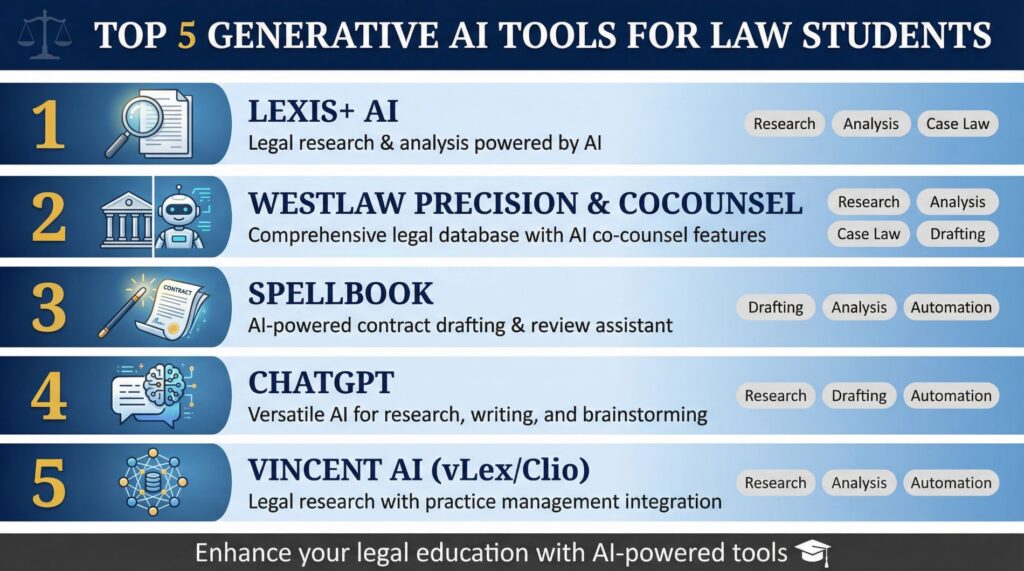
That being said, choosing the right AI tools makes all the difference between becoming more productive and getting dangerously dependent on technology that might lead you astray with hallucinated cases.
1. Lexis+ AI
Lexis+ AI stands out as the most trusted name in legal AI research for good reason. LexisNexis built its reputation over decades by providing reliable legal information, and Lexis+ AI extends that reliability into the generative AI space.
What makes this tool particularly valuable is its integration with the massive LexisNexis legal database. When you ask a question in natural language, the system doesn’t just generate an answer from thin air.
It searches through actual case law, statutes, and secondary sources, then provides answers with real citations you can verify and use in your work.
The hallucination problem that plagues general-purpose AI tools is virtually eliminated here. Every answer comes backed by sources from the LexisNexis library, and you get real-time Shepardization that tells you whether cases are still good law.
This matters enormously when you’re writing a memo or brief and need to confirm your citations won’t embarrass you in front of a professor or supervising attorney.
The conversational search feature let’s you refine your queries naturally. You might start by asking about Fourth Amendment search and seizure exceptions, then follow up with questions about how courts apply those exceptions in school settings.
The AI maintains context throughout your research session, making the process feel more like consulting with a knowledgeable librarian than wrestling with Boolean search operators.
Lexis+ AI also includes predictive insights that can help you understand which arguments might be most persuasive based on judicial history and trends. While you still need to apply your own judgment, having data-driven insights about how courts have ruled on similar issues gives you a significant advantage.
Most law schools provide students with access to LexisNexis products, so check with your library about getting access to Lexis+ AI. The interface has a learning curve, but the time you invest in mastering it will pay dividends throughout your legal career.
2. Westlaw Precision & CoCounsel
Thomson Reuters answers LexisNexis with its own powerhouse combination: Westlaw Precision and CoCounsel. These tools work together to provide a comprehensive AI-enhanced research environment that covers everything from basic case finding to sophisticated litigation analytics.
Westlaw Precision improves on the already robust Westlaw platform with AI that understands legal concepts, not just keywords. The search accuracy improvements mean you spend less time sorting through irrelevant results and more time analyzing cases that actually matter to your issue.
KeyCite integration provides the same essential function as Shepardizing, ensuring you know the current validity of any case you might cite.
CoCounsel deserves special attention as a standalone AI assistant within the Westlaw ecosystem. The AI-Assisted Research feature let’s you search both primary and secondary sources using natural language queries.
You can ask complex questions about legal doctrines and get back synthesized answers with citations to relevant cases, law review articles, and practice guides.
The AI Jurisdictional Surveys tool proves incredibly useful when you need to compare how different states handle a particular legal issue. Instead of running the same search fifty times across fifty jurisdictions, you can ask CoCounsel to survey how states approach, say, the duty to retreat in self-defense cases.
The tool generates a comprehensive overview with citations organized by jurisdiction.
The Search & Summarize features help you quickly digest lengthy practical law content. When you need to understand a complex area of law quickly, these tools can extract the key points from treatises and practice guides, giving you a conceptual framework before you progress on to the primary sources.
Westlaw also offers tools for analyzing specific judges and understanding litigation trends, which becomes particularly valuable during moot court competitions or when you’re trying to predict how a particular judge might rule.
Like LexisNexis, most law schools provide Westlaw access to students. The training materials Thomson Reuters provides are excellent, and taking advantage of their webinars and tutorials will help you maximize the platform’s capabilities.
3. Spellbook
Spellbook takes a different approach from the research-focused giants. This tool specializes in contract drafting and review, making it invaluable for transactional law courses and any work that involves reviewing or creating legal documents.
The real magic of Spellbook happens when you’re working on a contract. Upload a draft agreement, and Spellbook can suggest revisions, flag potentially risky language, identify missing standard clauses, and even draft new provisions based on what you’re trying to accomplish.
The tool understands common contract structures and can spot issues that might take a human reviewer much longer to catch.
The redlining feature streamlines the contract negotiation process. When you need to suggest changes to an agreement, Spellbook can generate suggested redlines based on your goals.
While you still need to review and refine these suggestions, having a starting point saves enormous amounts of time.
One particularly useful feature is the ability to identify missing boilerplate language. Every contract needs certain standard provisions covering things like governing law, dispute resolution, and force majeure.
Spellbook can flag when these essential clauses are missing or inadequate, helping you avoid potentially costly omissions.
The tool integrates with Microsoft Word, which means it fits naturally into your existing workflow. You don’t need to learn a completely new platform or transfer documents back and forth between systems.
What makes Spellbook especially attractive for law students is the free Academic Access program. You need to apply through their website with proof of enrollment, but once approved, you get access to professional-grade contract AI without paying the substantial subscription fees that practicing attorneys pay.
This free access gives you the opportunity to build skills in AI-assisted contract drafting before you enter the job market. Transactional law firms increasingly expect new associates to be proficient with these tools, so familiarizing yourself with Spellbook now gives you a competitive edge in recruiting.
Apply for Spellbook Academic Access
4. ChatGPT
ChatGPT deserves a place on this list despite not being specifically designed for legal work. Its versatility and zero cost make it an invaluable study aid, though you need to understand its limitations clearly.
The best use cases for ChatGPT in law school involve learning and studying as opposed to research you’ll cite in submitted work. When you’re struggling to understand a complex legal concept, ChatGPT can explain it in different ways until something clicks.
Ask it to explain the rule against perpetuities like you’re ten years old, then ask for a more sophisticated explanation with examples.
This iterative learning approach helps you build understanding faster than reading the same textbook paragraph five times.
ChatGPT excels at generating hypothetical fact patterns for practice. When you’re preparing for exams, you can ask it to create scenarios that test specific legal doctrines.
The more specific your prompt, the better the hypotheticals you’ll get.
Instead of “give me a contracts hypo,” try “create a fact pattern involving offer and acceptance issues with a mailbox rule twist and a question about whether a contract was formed.”
Building study outlines becomes much faster with ChatGPT’s help. You can feed it your class notes and ask it to organize them into a logical outline structure, then refine and expand on what it produces.
This process of reviewing and correcting the AI’s output actually reinforces your learning better than creating an outline from scratch in many cases.
The tool can also help you create study schedules that account for different course loads, exam dates, and your personal learning style. While you might not follow the schedule perfectly, having a structured plan helps reduce the anxiety that comes with juggling multiple subjects.
Here’s where you need to be extremely careful. ChatGPT makes up cases with abandon.
It will confidently cite “Johnson v. Smith (1987)” with a perfect-looking case summary, and none of it will be real.
Never cite anything ChatGPT tells you without verifying it independently in a proper legal database. Professors have zero tolerance for fake citations, and the consequences range from failed assignments to honor code violations.
Similarly, don’t rely on ChatGPT for nuanced legal analysis that you’ll send for credit. The tool doesn’t truly understand law, it predicts plausible-sounding text based on patterns in its training data.
For actual legal analysis, you need to do the thinking yourself or use purpose-built legal AI with verified sources.
The free version of ChatGPT is enough for most law school needs, though the paid version offers faster responses and access to more advanced features like web browsing and longer context windows.
5. Vincent AI (vLex/Clio)**
Vincent AI rounds out this list as a legal intelligence platform that combines vLex’s extensive global law library with sophisticated generative AI capabilities. While it may be less familiar than the big names, recent research suggests it outperforms general-purpose AI tools for legal work.
The platform handles natural language questions and returns answers supported by citations from the vLex database, which includes case law, statutes, regulations, and legal commentary from multiple jurisdictions. This global perspective can be particularly valuable if you’re interested in comparative law or international legal issues.
Vincent AI can draft legal arguments and memoranda based on your research, providing a starting point that you can refine and develop. Like all AI-drafted content, you need to review and revise carefully, but having a structured first draft saves significant time compared to starting from a blank page.
The contract and filing analysis features help you understand complex legal documents quickly. Upload a complaint, motion, or contract, and Vincent can summarize the key points, identify potential issues, and suggest relevant legal authorities.
This capability proves especially useful when you’re clerking or interning and need to get up to speed on matters quickly.
A 2025 randomized controlled trial provided compelling evidence for Vincent AI’s effectiveness with law students. The study found that students using Vincent AI were more productive in five out of six legal tasks compared to students using general-purpose reasoning models.
Even more importantly, students using Vincent encountered fewer hallucinations, meaning more reliable results they could actually use in their work.
This reduced hallucination rate addresses one of the biggest concerns about using AI for legal work. When the tool tells you something, you can have reasonable confidence that it’s based on actual legal authority as opposed to plausible-sounding fiction.
Vincent AI needs a subscription, but vLex often offers student discounts and free trials. Check their website for current academic pricing and trial options.
Some law schools also provide institutional access, so verify with your library whether you already have access through your school.
Making the Right Choice for Your Needs
After reviewing these five tools extensively, Lexis+ AI emerges as the top choice for most law students. The combination of comprehensive coverage, reliable citations, real-time validation, and likely availability through your law school makes it the most practical option for day-to-day legal research.
The integration with the full LexisNexis ecosystem means you’re learning a platform you’ll almost certainly use throughout your career. The investment you make in learning Lexis+ AI now will pay dividends for decades.
The lack of hallucinations gives you confidence that your research is sound, which matters enormously when you’re still developing your legal judgment.
That said, the smart approach involves using multiple tools for different purposes. Use Lexis+ AI or Westlaw for any research you’ll cite in submissions.
Add Spellbook when you’re working on transactional projects or contracts classes.
Keep ChatGPT handy for studying and generating practice problems. Consider Vincent AI if you need global legal perspectives or want a second opinion on your research.
The legal profession is being transformed by these technologies, and graduates who understand how to use AI effectively will have significant advantages in the job market. Firms are actively seeking associates who can leverage these tools to work more efficiently without sacrificing quality.
Start exploring these tools now as opposed to waiting until you’re drowning in 1L reading assignments. Take advantage of the training resources each platform provides.
Most offer webinars, tutorials, and practice exercises designed specifically for law students.
Dedicate a few hours to learning the basics of whichever tools you have access to, then use them consistently so the skills become second nature.
Sign up for Lexis+ AI through your law school library today. Spend an hour working through the introductory tutorials, then use it for your next research assignment.
Notice how much faster you find relevant cases and how much more time you have for actual analysis.
That’s the future of legal practice, and you’re getting to build those skills now.
Frequently Asked Questions
Can I cite AI-generated content in my law school assignments?
No, never cite content directly from AI without verifying it through primary sources. Tools like ChatGPT routinely hallucinate cases that don’t exist, and even legal-specific AI tools can occasionally make errors.
Use AI to find and understand sources, but always verify citations in official legal databases before including them in any submitted work.
Your professors expect citations to real, verifiable legal authority.
Will using AI tools in law school get me in trouble with honor code violations?
This depends entirely on your school’s policies and the specific assignment. Many law schools are still developing their AI use policies, so check your student handbook and ask professors about their expectations for each assignment.
Generally, using AI for research is acceptable as long as you verify everything and do your own analysis.
Using AI to write essays or exam answers typically violates honor codes. When in doubt, ask.
Do law firms expect new associates to know how to use these AI tools?
Increasingly, yes. Major law firms have adopted tools like Lexis+ AI, Westlaw CoCounsel, and various contract review platforms.
Firms expect new associates to learn these tools quickly, and demonstrating familiarity during interviews shows that you understand modern legal practice.
Include your AI tool experience in your resume, particularly if you’ve completed training certifications or used them in clinic work or internships.
How can I get access to these tools if my law school doesn’t provide them?
Most law schools provide access to at least Lexis and Westlaw, including their AI features. If yours doesn’t, contact your law library and ask about adding these resources.
For tools like Spellbook, apply for their free Academic Access program.
Vincent AI and others often offer student discounts or free trials. ChatGPT is free to use without any institutional access required. Join legal technology student organizations, as they sometimes provide access to tools through partnerships.
Which tool is best for preparing for law school exams?
ChatGPT is excellent for exam preparation because it can generate unlimited practice hypotheticals, explain concepts in different ways, and help you create study materials. However, you should verify important legal principles using proper legal databases.
For open-book exams where you need to research during the test, familiarity with Lexis+ AI or Westlaw becomes crucial since speed matters.
Practice with whichever research platform you’ll have access to during the exam.
Are AI tools useful for legal writing and law review work?
AI tools help with different aspects of legal writing. They can suggest organizational structures, identify weaknesses in arguments, and help you find extra supporting authority.
However, the actual writing, analysis, and citation checking must be your own work.
For law review work, AI tools can accelerate the source-finding process, but the rigorous citation checking law reviews require means you’ll verify everything manually anyway. Use AI to work faster, not to replace careful scholarship.
What’s the difference between using AI for legal research versus general research?
Legal research demands absolute accuracy because courts and clients rely on the information. General-purpose AI tools like ChatGPT lack access to current legal databases and frequently make up cases and statutes.
Legal-specific AI tools connect to verified legal databases and provide citable sources, though you still need to verify everything.
The consequences of citing a hallucinated case in a legal document are severe, including malpractice liability for attorneys and academic consequences for students. Always use specialized legal AI tools for any research you’ll cite professionally.
References:
[1] Lexis+ AI Overview, LexisNexis Legal Research Platform
[2] LexisNexis Reliability and AI Integration Study
[3] Spellbook Academic Access Program and Vincent AI Randomized Controlled Trial (2025)
[4] Thomson Reuters CoCounsel Features and Capabilities
[5] Comparative Analysis of AI Legal Research Tools for Students