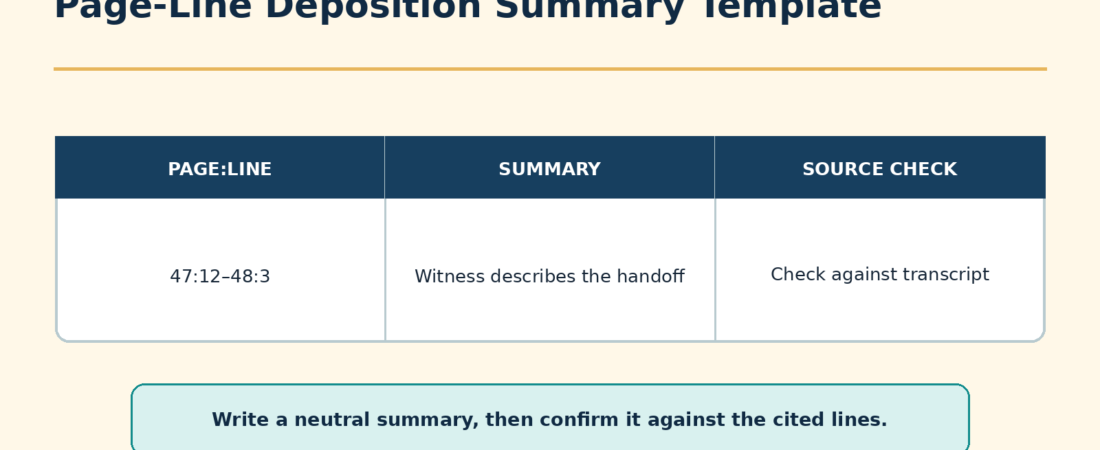
A page-line deposition summary is useful only when a reader can move from the summary back to the exact testimony. The format should make that check fast: identify the transcript version, preserve the original page and line numbering, summarize only the cited range, and keep analysis apart from the witness’s testimony.
Use the spreadsheet template
1. Copy the blank template. 2. Open Excel or Google Sheets. 3. Select cell A1 and paste.
The headings will go into separate columns. Replace the bracketed prompts with your information, then add a row for each record or testimony range.
Blank template
See and copy a fictional example
This example is for practice. It contains no real client information. Copy it into a separate sheet.
You can also select the text in either box and copy it using Ctrl+C on Windows or Command+C on Mac. If everything pastes into one column, choose tab as the separator in your spreadsheet’s split-text or Text to Columns tool.
What belongs in a page-line summary
| Field | Purpose | Example format |
|---|---|---|
| Transcript Version | Identifies the source used for every reference | Final, rough, or final with errata checked |
| Witness and Date | Prevents entries from different depositions being mixed | Witness name; YYYY-MM-DD |
| Page-Line Start/End | Points to the complete supporting range | 28:20 to 29:7 |
| Topic | Gives the reader a short navigation label | Notice of condition |
| Issue Tags | Allows filtering across a long transcript | NOTICE; CONTROL; DAMAGES |
| Neutral Summary | States what the cited testimony covers | One or two sentences without argument |
| Exact Words Needed? | Flags a passage that requires a separately verified excerpt | Yes, verify from source |
| Exhibit Reference | Connects testimony to the exhibit being discussed | Exhibit 5 |
| QA Status | Shows whether the entry and reference were checked | Unverified or verified |
| Reviewer Note | Holds strategy or follow-up outside the testimony summary | Compare with another witness |
Use the original transcript pagination
Do not cite the PDF viewer’s page count unless the transcript itself uses that same number. Cover pages, certificates, indexes, and exhibits can shift the viewer page away from the transcript page. The summary reference should follow the page and line numbers printed on the transcript.
Use a consistent house style, such as 45:10-45:18 or separate start and end columns. When testimony crosses a page, keep the break visible: 28:20-29:7. Do not compress that range into 28:20-7, because the ending page becomes ambiguous.
If relevant testimony stops and resumes later, use separate rows or list separate ranges. A broad continuous range such as 40:2-47:19 makes the reader review unrelated testimony when only separate passages support the summary. Separate rows also make later issue filtering more accurate.
Check the source version before relying on a citation
A rough transcript can differ from the certified final transcript. Pagination or wording may change, and a witness may review the transcript under the procedure applicable to the matter. Federal Rule of Civil Procedure 30(e), for example, addresses review of the transcript or recording when properly requested and permits changes in form or substance with reasons stated. State rules and case orders can differ.
Put the source version in the header and in the working data when multiple versions are circulating. Before the summary is used for a motion, examination outline, or designation, check the references against the version the team will cite. Record whether an errata sheet was reviewed. These are practical controls, not a universal filing rule.
Neutral summaries, exact excerpts, and analysis
The neutral summary should describe the testimony within the cited range. If exact wording matters, copy it only after checking the original transcript and preserve the punctuation needed to understand it. Label the excerpt as an exact excerpt. Do not place quotation marks around a paraphrase.
Strategy belongs in a reviewer-note field. For example, “compare this account with the maintenance log” is a follow-up instruction, not witness testimony. Keeping it separate helps prevent an internal inference from being repeated later as though the witness said it.
AI can create a working draft, but the source transcript remains controlling. A model may join distant passages, omit a qualifier, confuse a question with an answer, or create an incorrect page-line reference. The workflow in how to use AI for deposition summaries should therefore end with a human citation check. For broader files, see AI legal document summarization.
Page-line, topical, and narrative summaries
| Format | Organization | Best fit | Main risk |
|---|---|---|---|
| Sequential page-line | Follows transcript order | Fast navigation and a complete transcript digest | Related testimony can be scattered across many rows. |
| Topical with page-line citations | Groups entries by issue | Issue review, motion preparation, and witness comparison | Moving passages out of sequence can hide context. |
| Narrative with citations | Explains the testimony in prose | Case handoff or a fast overview | A long narrative can make individual propositions harder to verify. |
The formats can work together. A sequential page-line table can serve as the checked source index. A topical view can filter the same entries by issue tag. A short narrative can then explain the major points while retaining citations. Do not call a topical summary “page-line” merely because a few citations appear at the end of a paragraph. Each proposition should remain traceable to its supporting range.
Choose issue tags before summarizing
A small tag list is easier to use than dozens of overlapping labels. A premises case might use BACKGROUND, CONTROL, NOTICE, INSPECTION, CAUSATION, DAMAGES, CREDIBILITY, and EXHIBIT. Define each tag once and apply it consistently. Add a new tag only when an existing one cannot do the job.
Tags organize review; they do not supply legal conclusions. “NOTICE” can identify testimony that may relate to notice without asserting that the legal element has been proven.
Fictional worked example
| Range | Topic | Tags | Neutral summary | Status |
|---|---|---|---|---|
| 12:4-12:18 | Role and duties | BACKGROUND; CONTROL | The fictional witness describes responsibility for the fictional facility’s daily inspection log. | Illustrative row only; verify against the actual source |
| 28:20-29:7 | Notice of condition | NOTICE | The fictional witness describes receiving a message about the fictional loading gate before the incident date. | Exact wording still must be checked before any excerpt is inserted |
This table is invented solely to demonstrate structure. It is not actual testimony, does not describe a real dispute, and should not be cited for any proposition.
Quality-control pass
- Confirm the witness, date, and transcript version.
- Check that every range uses transcript page and line numbers.
- Open the start and end of each range and confirm it supports the whole summary.
- Split noncontiguous passages into separate references.
- Check speaker attribution, especially where objections or colloquy interrupt an answer.
- Confirm every exact excerpt character by character against the source.
- Review cited exhibits and identify whether the transcript describes, marks, or admits them.
- Keep reviewer analysis in its own field.
- Recheck references after receiving a final transcript or errata.
A Clearbrief review may be relevant when the next step is checking citations in drafted legal writing, while the deposition table remains the source index for testimony. Paralegals building the wider process can also use the controls in the paralegal AI guide.
Sources checked October 4, 2026.