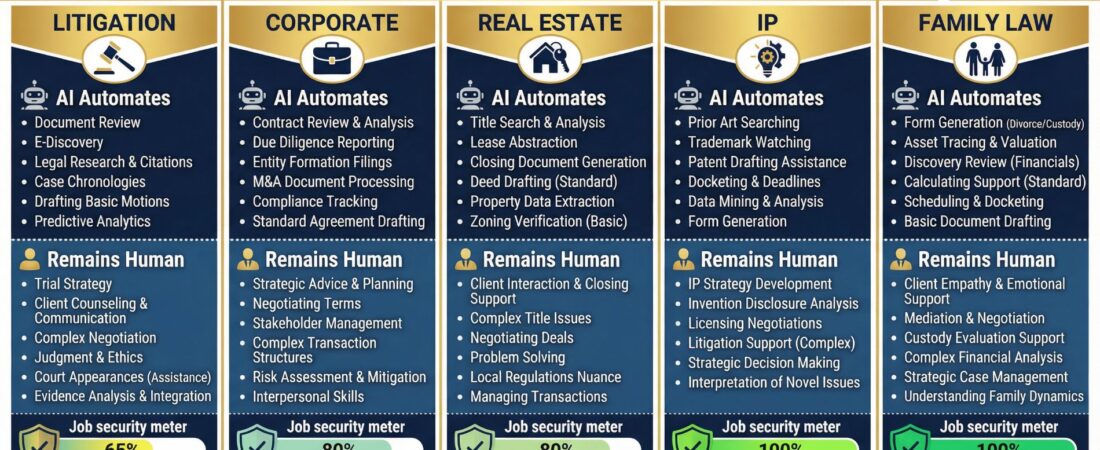
The short answer is no. You’re not losing your job to AI in 2026. Here’s why…
Your role will change, but the profession stays intact for the foreseeable future.
What I found contradicts the panic you’ve probably seen on LinkedIn. AI handles certain tasks faster than you can, but it fails at the work that makes you valuable to your firm.
Let me show you exactly what’s happening and how you can prepare.
The Real Story About Paralegals and AI
AI excels at language-based tasks. Document drafting, contract analysis, and basic legal research happen faster with AI assistance.
A recent study found paralegals achieved 50% time savings on administrative tasks when using AI tools properly.
But efficiency gains don’t equal job elimination.
AI cannot interact with clients the way you do. It cannot read a room during a witness interview.
It cannot understand the subtle context of a case or make judgment calls based on years of experience.
These capabilities stay exclusively human, and law firms know it.
Your job changes shape, but it doesn’t disappear.
The tedious parts of your work get automated. The meaningful parts expand. You spend less time summarizing depositions and more time analyzing complex legal issues.
You stop doing routine contract reviews and start catching the errors AI makes in its outputs.
This shift creates opportunities for paralegals who adapt and problems for those who resist.
Where AI Actually Helps (And Where It Fails)
AI tools help with specific tasks you probably find boring anyway.
Document review happens faster. AI scans hundreds of pages and flags relevant sections in minutes instead of hours.
Contract analysis becomes semi-automated. AI identifies standard clauses, spots missing terms, and compares versions side by side.
Legal research gets streamlined. AI pulls relevant cases and statutes faster than manual searches through legal databases.
Document drafting speeds up. AI generates first drafts of routine documents based on templates and prior work.
These improvements sound threatening until you use AI tools yourself and see their limitations.
AI invents case citations that don’t exist. It confidently presents false legal precedents.
It misses context and nuance in every complex situation.
It cannot tell when a client needs reassurance or when a witness is lying.
You need to verify every single output AI produces. This verification role isn’t busywork.
It’s the core of how law firms use AI safely.
🔧 Essential Tool for Modern Paralegals
LegalTech AI Assistant Pro gives you hands-on experience with the exact AI tools reshaping legal work. The platform includes contract analysis, document review automation, and legal research capabilities used by major firms.
The Skills That Keep You Employed
Three skill categories matter most as AI becomes standard in law firms.
Technical competency with AI tools forms the baseline. You need to write effective prompts for legal AI, recognize when these systems produce hallucinations, and stay current with new legal technology.
This isn’t optional anymore.
Paralegals who can’t work with AI will struggle to find positions. Paralegals who master AI tools become significantly more valuable than those working in the old model.
Analytical and critical thinking skills become your main value proposition. As administrative work decreases, your ability to catch subtle legal issues, identify inconsistencies in AI outputs, and apply complex reasoning matters more than ever.
The paralegal who spots the error in an AI-generated document before it goes to court is worth far more than someone who just follows procedures.
Interpersonal abilities grow in importance. As machines handle routine tasks, firms value paralegals who excel at client communication, witness management, and collaboration.
You cannot automate empathy or relationship building.
Client work requires reading emotional cues and adjusting your approach. Witness interviews need rapport and trust.
Team coordination depends on understanding personalities and motivations.
AI handles none of this.
How Your Daily Work Changes
Picture your typical workday now. How much time do you spend on document summarization, routine contract management, and basic legal research?
That time shrinks dramatically or disappears entirely.
You’ll spend more time analyzing AI outputs for errors, conducting complex legal analysis that requires contextual understanding, and managing quality control across AI-generated work.
Some of your colleagues might lose their positions, particularly entry-level paralegals focused purely on administrative tasks. Law firms will extract efficiency gains from AI, and that means smaller teams in some cases.
But the profession doesn’t collapse. The paralegals who stay handle critical work that AI cannot do alone.
Your role becomes less about processing documents and more about applying expertise. Less about following procedures and more about solving problems.
Less about routine tasks and more about judgment calls.
This shift favors experienced paralegals who can show value beyond administrative work.
Why 2026 Is Way Too Soon
Even if a dramatic transformation were coming, we’re talking about a decade or more away, not months.
AI tools still make obvious errors. Courts are still figuring out how to handle AI in legal proceedings.
Firms are still in early-stage integration.
The regulatory environment around AI in law is still forming.
Most law firms proceed with caution as opposed to aggressive adoption. They’ve seen high-profile failures where AI generated fake case citations or produced ethically problematic outputs.
They know the risks of moving too fast.
Mass deployment of AI takes years, not months. Training staff takes time.
Updating workflows takes time.
Building trust in new systems takes time. Overcoming resistance to change takes time.
By the time AI reaches a level where it could theoretically handle legal work without human oversight, we’re looking at 2035 or later, not 2026.
You have time to adapt. Use it wisely.
What Happens to Different Paralegal Specialties
The impact of AI varies depending on what type of paralegal work you do.
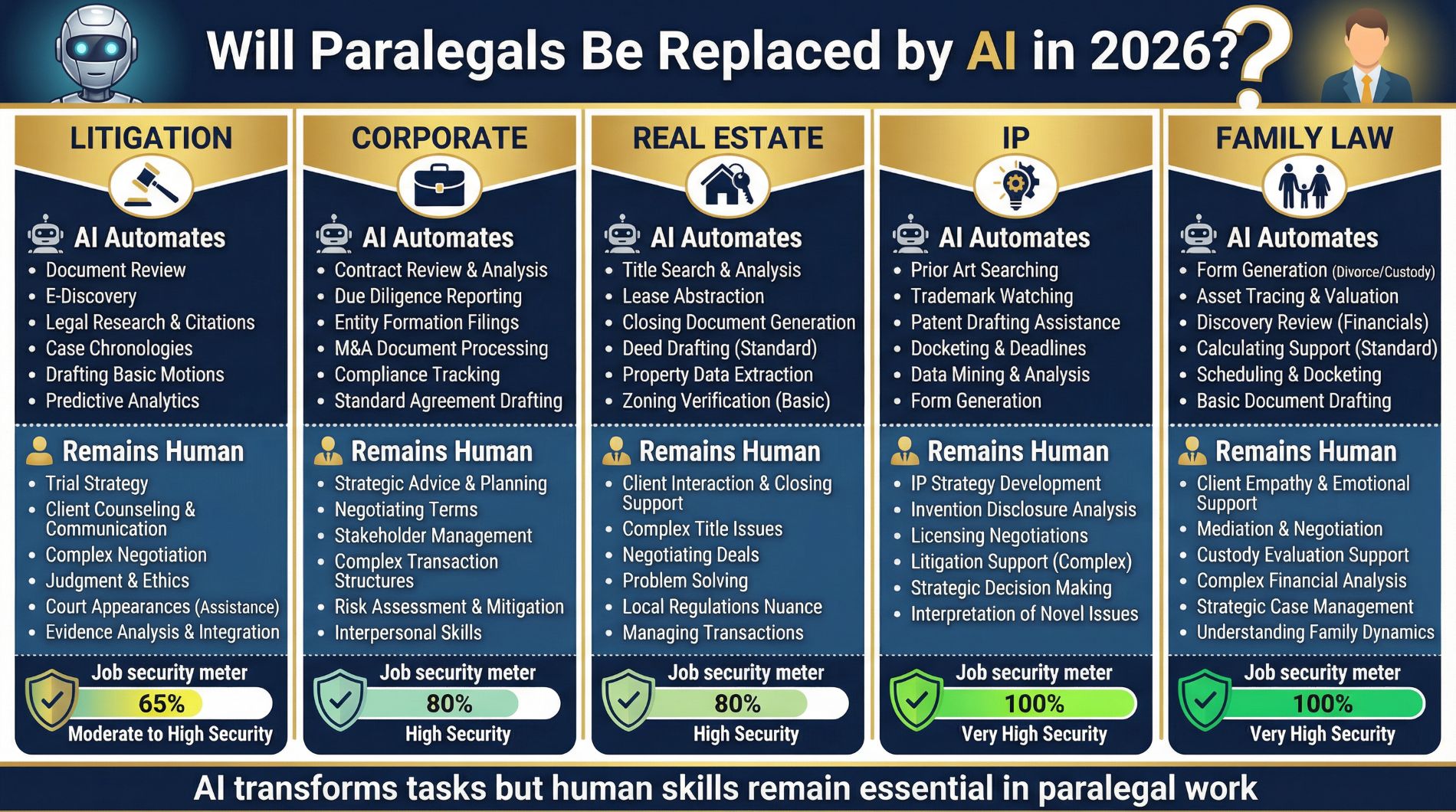
Litigation paralegals see AI assist with discovery review, timeline creation, and exhibit preparation. But witness prep, client coordination, and trial support stay heavily human-dependent.
Your role shifts but stays secure.
Corporate paralegals experience more automation in routine contract work and compliance documentation. But deal coordination, due diligence oversight, and relationship management keep you essential.
Real estate paralegals find AI speeds up title reviews and document preparation. But client communication, problem-solving during closings, and coordination between parties still need you.
Intellectual property paralegals use AI for prior art searches and patent application drafting. But strategy discussions, inventor interviews, and managing prosecution timelines stay your territory.
No specialty faces finish replacement. Every specialty faces some level of task automation balanced by expanded responsibilities elsewhere.
| Paralegal Specialty | Tasks AI Automates | Tasks That Remain Human | Job Security Level |
|---|---|---|---|
| Litigation | Discovery review, timeline creation, basic research | Witness prep, client coordination, trial support | High |
| Corporate | Routine contracts, compliance docs, entity management | Deal coordination, due diligence, client relations | Moderate to High |
| Real Estate | Title reviews, standard documents, filing | Closing coordination, problem resolution, client contact | High |
| Intellectual Property | Prior art searches, application drafts, docketing | Strategy input, inventor interviews, prosecution management | High |
| Family Law | Document preparation, financial analysis, research | Client support, case coordination, emotional intelligence | Very High |
The Paralegals Who Should Actually Worry
If you refuse to learn AI tools, you face genuine career risk. Firms will increasingly expect basic AI literacy from all paralegals.
You don’t need to become a programmer, but you need to understand how these tools work and where they fail.
If your entire skill set revolves around tasks AI handles well, you need to expand your capabilities. Document formatting, basic research, and routine administrative work are exactly what AI automates first.
If you’re in an entry-level position at a firm aggressively pursuing efficiency gains, your role might disappear through attrition or restructuring. Not because AI replaced you specifically, but because your firm needs fewer total paralegals to handle the same workload.
But if you’re willing to learn, grow your analytical skills, and develop expertise in both law and technology, you’ll likely end up better off than you are now.
The market will favor paralegals who sit at the intersection of legal knowledge and technological competency. Firms will pay more for these hybrid professionals because they deliver value AI alone cannot provide.
What Smart Paralegals Are Doing Right Now
The paralegals preparing best for an AI-enabled legal market are taking specific actions today.
They’re experimenting with AI tools on low-stakes work to learn capabilities and limitations. They’re taking courses on legal technology and prompt engineering.
They’re developing deeper expertise in areas AI struggles with, like client communication and complex analysis.
They’re positioning themselves as the bridge between traditional legal work and AI-assisted workflows. They’re becoming the go-to person in their firm for questions about AI tools.
They’re volunteering to help implement new technology.
They’re documenting the judgment calls and expertise they apply daily, making their value visible to management. They’re building relationships with attorneys who appreciate their contributions beyond administrative tasks.
They’re treating this transition as an opportunity as opposed to a threat.
You can do the same. The question is whether you will.
The Realistic Path Forward for Paralegals and AI
Your job survives 2026, 2027, and probably 2036. The profession adapts as opposed to disappears.
Some positions are lost through efficiency gains, but the core role stays intact.
The paralegal profession in five years looks different but recognizable. You spend less time on busywork and more time on analysis.
You work alongside AI tools as opposed to competing against them.
You earn more if you’ve developed the right skills, and you struggle if you haven’t.
Law firms still need humans who understand context, make judgment calls, build client relationships, and catch errors. They just need fewer humans to handle the same amount of work.
The paralegals who thrive are those who embrace AI as a tool that makes them more capable as opposed to a threat to their existence. They learn the technology, develop skills AI cannot copy, and position themselves as essential members of a modern legal team.
The ones who struggle are those who resist change, cling to workflows that AI handles better, and hope the technology goes away.
It won’t.
Your Action Plan Starts Today
You don’t need to panic, but you do need to prepare. Start by getting hands-on experience with AI tools designed for legal work.
Learn how they work, where they fail, and how to verify their outputs.
Develop your analytical and critical thinking capabilities. Take on projects that need complex reasoning as opposed to just following procedures.
Demonstrate value beyond administrative tasks.
Strengthen your interpersonal skills. Get better at client communication, witness interviews, and team collaboration.
These abilities become more valuable as routine work gets automated.
Document your expertise and the judgment calls you make daily. Make your value visible to management.
Position yourself as someone who understands both traditional legal work and modern technology.
Stay informed about developments in legal AI. Read industry publications, join professional groups focused on legal technology, and network with other paralegals adapting to these changes.
The paralegal profession faces significant change, but you control how you respond to it.
The Bottom Line About Paralegals Being Replaced by AI
Paralegals will not be replaced by AI in 2026 or any time soon. The job changes, but it doesn’t vanish.
Firms need fewer paralegals to handle the same workload because of efficiency gains, but they still need paralegals who bring expertise, judgment, and human skills AI cannot copy.
Your career security depends on your willingness to adapt. Learn the tools. Develop skills AI cannot match.
Position yourself as someone who bridges traditional legal expertise with modern technology.
The paralegals who do this will likely earn more and do more interesting work than before. The ones who resist will face an increasingly difficult job market.
You have time to prepare. The transformation happens over years, not months.
Use that time to build the skills and capabilities that make you valuable in an AI-enabled legal market.
Your job isn’t disappearing in 2026. But it is changing.
How you respond to that change decides whether you thrive or struggle in the years ahead.
The choice is yours to make.