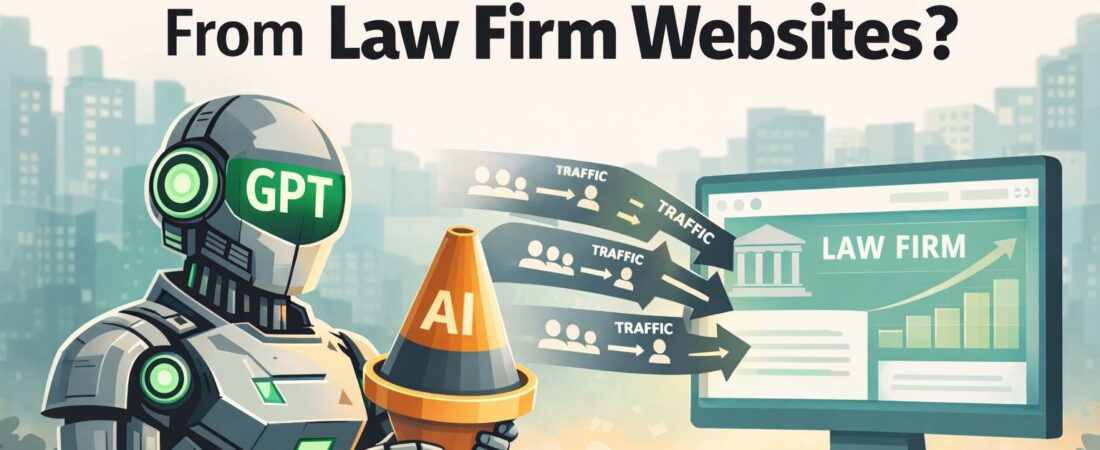
If you’re running a law firm in 2026, you’ve probably noticed a strange pattern in your analytics.
Your articles are still showing impressions.
Your rankings haven’t completely collapsed.
But clicks, especially on informational content, are down.
This has led a lot of attorneys to the same conclusion:
“AI is stealing our traffic.”
According to legal SEO specialist Jared DeValk, that’s only partially true, and it’s missing the bigger picture.
You also might like to read:
- Law Firm SEO in 2026: What AI Overviews Are Really Taking Away (And What Still Works)
- If I Started a Law Firm in 2026: A 90 Day SEO and Brand Plan
- How Law Firms Can Use Reddit and Online Communities Without Getting Banned or Looking Spammy
The Real Reason Informational Searches Are Vanishing
The shift isn’t about SEO failing.
It’s about human behavior changing.
For decades, if someone had a legal question, their options were limited:
- Call a law firm
- Read a book
- Pick up a pamphlet
- Search and read long-form articles
Now, AI tools can answer basic legal questions instantly.
And from the consumer’s point of view, that’s exactly what they want.
Most people searching things like:
- “What happens after a DUI?”
- “What’s the penalty for domestic assault in my state?”
- “How does child custody work?”
aren’t trying to hire an attorney yet. They’re trying to understand their situation.
AI removes friction from that step.
Consumers Never Wanted the Website: They Wanted the Answer
This is the uncomfortable truth for marketers and law firms alike.
People didn’t visit legal websites because they wanted to.
They visited because that was the only way to get information.
Now that AI can summarize laws, penalties, and processes, the need to click disappears.
That doesn’t mean your content failed.
It means it succeeded so well that machines can now digest it and relay it instantly.
Why Google Is Willing to Cannibalize Itself
One of the more interesting points Jared makes is that this shift isn’t just hurting publishers, it’s hurting Google’s ad business too.
Informational searches used to be monetized with ads.
Now, AI answers often appear before ads are even relevant.
Google wouldn’t do this unless it believed:
- Users expect it
- The long-term value outweighs the short-term loss
This signals that informational click loss isn’t a temporary experiment. It’s a permanent behavior shift.
Why This Is Actually Good for Law Firms
Here’s where most panic narratives fall apart.
People who only want information were rarely good leads anyway.
In the past:
- Firms answered free questions
- Consultations were wasted
- Time was spent educating instead of representing
Now, prospects arrive better informed.
They’ve already:
- Learned the basics
- Understood potential outcomes
- Identified whether they actually need a lawyer
That changes the quality of the conversation entirely.
Informational Content Still Influences Who Gets Chosen
Even if a prospect never clicks your article, your content still plays a role.
AI doesn’t randomly choose which firms to mention.
It looks for signals of authority and trust.
That means:
- Well-written content still matters
- Clear explanations still matter
- Consistent expertise still matters
Your content trains both search engines and AI tools on who should be trusted.
When someone finishes researching and is finally ready to hire, the firms that have been consistently visible, even quietly, are the ones that feel familiar.
The Shift From Traffic to Influence
The biggest mistake law firms can make right now is judging content purely by clicks.
Informational content is no longer just about:
- Pageviews
- Time on site
- Direct conversions
It’s about:
- Being part of the research phase
- Being recognized by AI systems
- Being recalled at decision time
That influence doesn’t always show up cleanly in analytics, but it absolutely shows up in client choice.
People Are Changing
Informational legal searches aren’t disappearing because law firm marketing is broken.
They’re disappearing because people finally have faster ways to learn.
For firms that understand this shift, informational content still plays a critical role, just a quieter one.
It educates early.
It builds trust invisibly.
And it positions your firm to win when the moment to hire actually arrives.
This topic and the inspiration for this article came up during this AI for Law Firms podcast episode with Jared DeValk from Nashville Digital.