Reading through a 50-page contract at 10 PM because you need to brief a client in the morning gets old fast. So does spending your entire Wednesday reviewing discovery documents when you could be working on actual legal strategy.
AI tools that summarize legal documents have changed how legal work gets done. These platforms read contracts, pleadings, depositions, and case files in minutes, then pull out the information that actually matters.
I’m going to show you which tools work best, what they can and can’t do, and how to pick one that fits your practice.
AI for Lawyers: Court-Safe Workflows for Research, Drafting, and Compliance
by Marcus Ellington

What These Tools Actually Do
When you AI summarize legal documents, the software uses natural language processing trained specifically on legal content. The system recognizes legal terminology, understands document structure, and knows which sections typically contain critical information.
Upload a contract and the tool identifies parties, payment terms, termination clauses, liability provisions, and anything unusual. Feed it litigation documents and it extracts legal holdings, material facts, applicable law, and court reasoning.
The technology works through two main methods. Extractive summarization pulls important sentences directly from your document, keeping the original language intact.
Abstractive summarization rewrites the content in condensed form while preserving meaning.
Professional legal AI tools combine both approaches based on what you’re reviewing.
The practical outcome means a 30-page licensing agreement gets condensed to two pages of key terms and flagged risks in under 15 minutes. A complex litigation file with thousands of pages that would take weeks to manually organize gets processed in days or even hours.
The Real Benefits (Beyond Just Speed)
Time savings matter, but they’re not the only advantage.
Consistency Across Documents
You stay sharp for the first ten contracts you review in a day. By contract fifteen, you’re skimming.
By contract twenty, you’re missing things.
AI tools maintain the same level of attention on document one and document one thousand. The system applies the same analysis criteria every single time, which reduces errors and oversight.
Risk Identification You’d Otherwise Miss
These platforms flag inconsistencies between document sections, spot unusual provisions, identify compliance issues, and highlight clauses that don’t match standard practice.
A medical malpractice case might involve hundreds of patient records. An AI system cross-references all of them simultaneously and spots pattern discrepancies that would take a human reviewer days to connect.
Research Speed
Rather than manually searching case law databases, AI tools that AI summarize legal documents cross-reference many sources at once. The system identifies relevant precedents and controlling authorities 5-10 times faster than traditional research methods.
This capability helps with case analysis, settlement positioning, and trial prep.
Top Tools That AI Summarize Legal Documents
Several platforms have emerged as serious options for legal professionals. Each serves different practice areas and firm sizes.
CaseText (Compose AI)
CaseText combines AI summarization with legal research capabilities. The platform analyzes case law, statutes, and uploaded documents, then generates research memos and summaries.
The system works particularly well for appellate work and complex legal research projects. You can upload briefs, get summaries of opposing counsel’s arguments, and identify potential counterarguments.
[Check Current CaseText Pricing Here]
Harvey AI
Harvey AI specializes in contract analysis and litigation support. The platform handles due diligence, contract review, and discovery document organization.
The tool’s strength is processing large document volumes quickly while maintaining high accuracy. Law firms handling M&A transactions or complex litigation rely on Harvey for initial document review before attorneys step in.
Upload a stack of contracts and Harvey identifies non-standard clauses, flags potential risks, and creates comparison charts showing how terms differ across agreements.
Lex Machina
While primarily known as a legal analytics platform, Lex Machina includes document summarization features focused on litigation outcomes and judicial behavior patterns.
The system analyzes court filings to forecast case outcomes based on historical data. This helps with settlement negotiations and trial strategy decisions.
Everlaw
Everlaw targets litigation teams managing discovery. The platform combines document review, AI summarization, and collaboration tools in one system.
Teams can review documents simultaneously, add annotations, and build case timelines. The AI component surfaces relevant documents and connections between materials that might otherwise stay hidden in massive document collections.
How to Pick the Right Tool
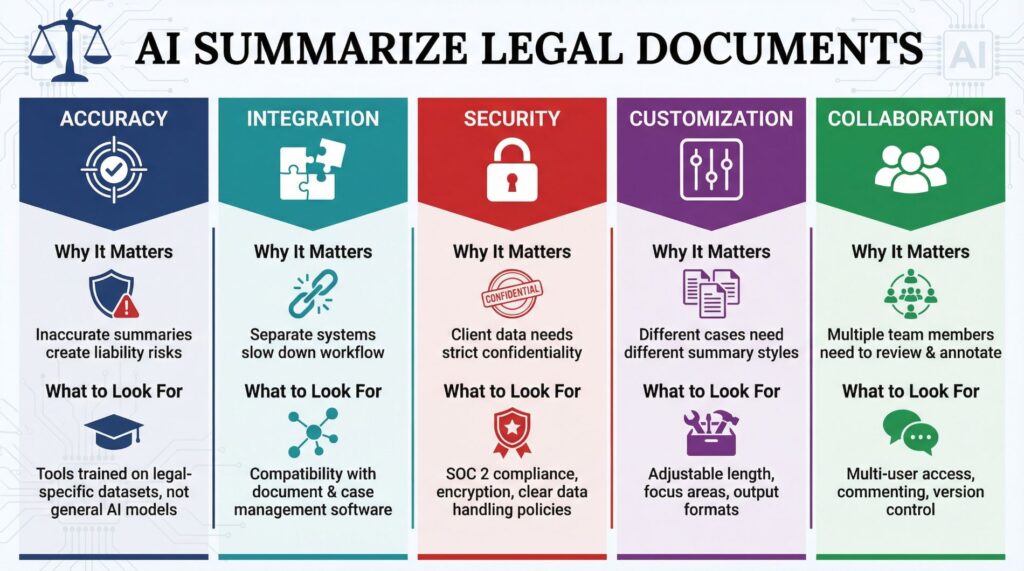
| Feature | Why It Matters | What to Look For |
|---|---|---|
| Accuracy | Inaccurate summaries create liability risks | Tools trained on legal-specific datasets, not general AI models |
| Integration | Separate systems slow down workflow | Compatibility with your current document management and case management software |
| Security | Client data needs strict confidentiality | SOC 2 compliance, encryption, clear data handling policies |
| Customization | Different cases need different summary styles | Adjustable summary length, focus areas, output formats |
| Collaboration | Multiple team members need to review and annotate | Multi-user access, commenting features, version control |
The tool you choose depends heavily on practice area. Litigation-focused platforms excel at discovery and deposition analysis.
Transactional tools specialize in contract review and due diligence.
Solo practitioners need simple interfaces and reasonable pricing. Large firms need enterprise features with robust security and integration capabilities.
Most platforms offer free trials. Test them with actual documents from your practice to see how they perform on real work, not just demo materials.
What AI Legal Summarization Can’t Do
Understanding limitations matters as much as knowing capabilities.
These tools excel at identifying what documents say but struggle with what they mean in context. A summary might flag an unusual indemnification clause, but determining whether that clause creates acceptable risk depends on factors the AI doesn’t know about the parties, transaction, and industry.
AI systems generate hallucinations occasionally, which means confident-sounding statements with no basis in the source document. A summary might cite a legal principle that doesn’t exist in the original text.
Professional-grade legal tools minimize this problem, but it never disappears completely.
This is exactly why AI summaries work best as a first pass, not a substitute for human review.
The technology also misses novel or creative provisions. If a contract contains unusual risk allocation language without clear precedent, the AI might overlook it or mischaracterize it.
Experienced legal judgment stays irreplaceable here.
How to Actually Use These Tools in Practice
Getting value from AI summarization needs more than just uploading documents and hoping for magic.
Start with lower-stakes documents. Test the system on routine contracts or preliminary discovery materials before using it on critical matters. This helps you understand the tool’s strengths and weaknesses without risking client interests.
Create standardized review workflows. Set up processes where AI generates the initial summary, then a junior attorney reviews and refines it, and finally a senior attorney signs off. This hybrid approach captures efficiency gains while maintaining oversight.
Customize output templates. Most tools let you specify what information to prioritize. A commercial lease review template should focus on different clauses than an employment agreement template.
Build templates for your most common document types.
Compare summaries against originals initially. Spend time checking AI output against source documents when you first start using a tool. This calibrates your confidence level and helps you spot patterns in where the system performs well or struggles.
Train your team together. Everyone needs to understand the tool’s capabilities and limitations. Mixed understanding leads to inconsistent quality and missed opportunities.
The Cost-Benefit Reality
Most platforms that AI summarize legal documents charge between $50-$300 per user per month for professional plans. Enterprise solutions run higher depending on firm size and features needed.
Compare that to attorney time. If a lawyer billing at $300/hour saves four hours per week using AI summarization, the tool pays for itself many times over.
Even at more modest time savings, the math works out strongly in favor of adoption.
The real cost isn’t subscription fees. The cost is the learning curve during implementation and the occasional error that needs correction.
Budget time for training and workflow development when you first adopt these tools.
Solo practitioners can start with more affordable options and scale up as practice volume grows. Larger firms benefit from enterprise solutions despite higher costs because integration and collaboration features become essential at scale.
[Compare AI Legal Tool Pricing]
Privacy and Security Considerations
Client confidentiality isn’t optional. Before uploading any documents to an AI platform, verify several things:
The vendor’s data handling policy needs to be crystal clear. Some AI tools use uploaded content to train their models, which creates confidentiality problems.
Look for platforms that explicitly state they don’t use client data for model training.
Encryption matters both in transit and at rest. Documents should be encrypted when transmitted to the platform and while stored on their servers.
SOC 2 Type II compliance provides independent verification that the vendor maintains proper security controls. This certification matters more than vendor promises.
Check whether the platform allows you to delete documents permanently after you finish with them. Some systems keep data indefinitely, which creates ongoing risk.
Making the Switch
You don’t need to improve your entire practice overnight. Start small, learn the system, then expand usage as confidence grows.
Pick one document type or practice area to focus on initially. If you handle a lot of commercial leases, start there.
If discovery document review consumes most of your time, begin with litigation support tools.
Track time savings and error rates during the first three months. Measure how long document review took before and after AI implementation.
Note any mistakes or oversights the system made.
This data helps you refine workflows and decide whether to expand usage.
The competitive pressure is building. Firms using AI summarization finish work faster and more cost-effectively than firms still relying entirely on manual review.
Over the next few years, using these tools won’t make you innovative, it will make you competitive.
The firms gaining advantage now are those learning these systems today, understanding where they add value and where human judgment still dominates.
The Bottom Line
AI tools that summarize legal documents deliver genuine efficiency gains without requiring finish practice overhauls. A solo practitioner can start using these platforms immediately.
A 50-person firm can apply them gradually across departments.
The technology won’t replace legal professionals. It will multiply what each professional can accomplish.
A lawyer who once handled 20 matters competently can now handle 30 or 40 without sacrificing quality or working 80-hour weeks.
The question isn’t whether to adopt AI summarization. The question is which tool fits your practice and how quickly you apply it before competitors gain an insurmountable efficiency advantage.
You’ll still need to read documents. You’ll still apply legal judgment.
You’ll still advise clients based on experience and expertise.
You’ll just spend less time on the mechanical parts and more time on the parts that actually need a trained legal mind.
That seems like a trade worth making.