AI marketing for law firms is finally past the hype phase. In 2026, the firms winning are not “using AI to write blog posts.” They are using AI to:
- Show up where prospects now get answers (Google AI Overviews and other answer engines)
- Clarify and sharpen their offer so they attract better cases
- Convert more leads into signed clients by eliminating intake leakage
This guide breaks the best AI marketing moves into three buckets: Traffic, Offer, and Conversion. It also includes practical processes and “agentic AI” workflows that a real firm can implement without turning your operation into a science project.
Why did we choose these categories to tackle in this guide?
Traffic: Like any business, your law firm needs to get in front of potential prospects. This means your marketing must have at least one process for getting traffic. For example as a baseline, many law firms opt for integrating processes which attract organic search traffic for their specific type of law, and in their specific geography.
Offer: Your law firm must effectively communicate what services it provides.
Conversion: Then to top it off, once you are (a) in front of a prospect and (b) what you offer is effectively communicated, you must turn that prospect into a client. AI can now spin up copywriting, landing pages, entire funnels, follow up emails, and even agents which do all of the above.
One note before we start: lawyers must use AI in a way that protects confidentiality, ensures competent review, and avoids misleading advertising. The ABA’s Formal Opinion 512 is the clearest baseline for ethical duties around generative AI, including competence, confidentiality, communication, supervision, and fees.
Category 1: Traffic
AI tools and processes to bring more traffic to your firm
The 2026 reality: traffic is shifting from clicks to citations
In 2026, many prospective clients get what they need from AI-generated answers before they ever click a website. That means your goal is no longer just “rank on page one.” Your new goal is:
- Get cited and recommended in AI answers
- Still rank in traditional search results
- Dominate local intent channels where legal leads still convert at high rates
NOTE: Make sure your law firm has setup Bing Webmaster Tools. They’ve added a new BETA analytics feature which shows you how many times you’ve been mentioned in AI overviews.
Here’s an example of our Bing Webmaster Tools AI Performance for the past 7 days:
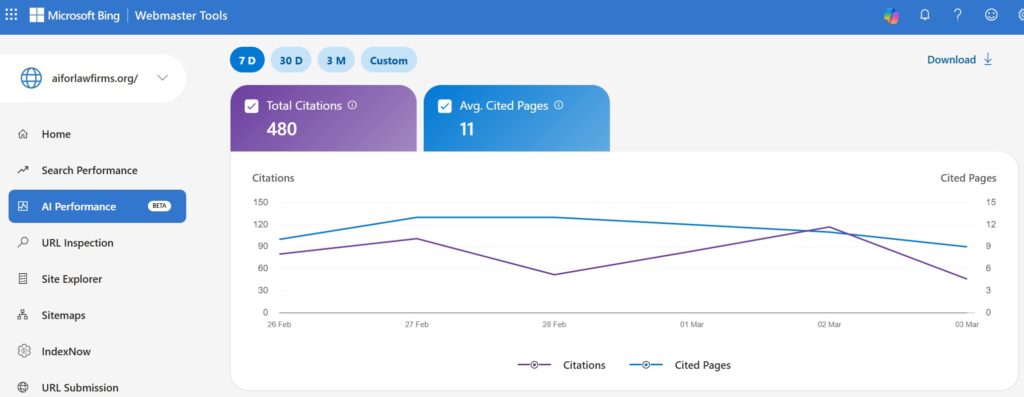
- We were mentioned in a total of 480 citations in Bing
- 11 average cited pages
This shift is increasingly described as Generative Engine Optimization (GEO) or “AI optimization,” and it shows up as a major marketing trend for law firms in 2026.
Traffic Play #1: GEO plus SEO (the modern organic foundation)
Traditional SEO still matters. But in 2026, you should build content and site structure in a way that makes AI systems more likely to trust and cite you.
What GEO-ready legal content looks like:
- Jurisdiction clarity: “This applies in Colorado” or “This is a general overview, state laws vary.”
- Direct answers first: start sections with a clear answer, then explain.
- Tight topic coverage: fewer fluffy posts, more comprehensive clusters.
- Authority signals: attorney bios, review timestamps, citations, and consistent entity info across the web.
- FAQ blocks that mirror real user questions.
Many legal marketing sources now explicitly recommend building “citation-worthy” content for AI-driven discovery, not just keyword-targeted pages.
High impact GEO page types for most firms:
- Practice area hub page (the main “money page”)
- “Do I have a case?” and eligibility-style pages (pre-qualify traffic)
- “What is the process?” pages (reduce fear and uncertainty)
- Fee and cost framing pages (careful with ethics and state rules)
- Location pages that are actually helpful (not thin duplicates)
AI tools that help here (without turning your site into generic sludge):
- Topic clustering and gap analysis tools (pair AI with real competitor review)
- On-page optimization tools for clarity and coverage (use them as guardrails, not dictators)
- Technical SEO crawlers and schema testing tools
Agentic workflow: the GEO Content Planner Agent
If you want an “agentic” approach that is actually useful, build a simple agent that outputs a 60–90 day content and internal linking plan.
Inputs:
- Practice areas
- Target locations
- Case types you want and do not want
- Proof points (credentials, awards, years in practice)
- Intake constraints (who answers calls, hours, response time)
Outputs:
- A page map (hubs, supporting pages, FAQs)
- A weekly publishing plan
- An internal linking blueprint
- A schema checklist
- A “citations and entity signals” checklist
This is one of the few AI agents that can produce compounding gains because it creates a repeatable publishing and optimization cadence.
Traffic Play #2: Local intent capture (still the fastest path to cases)
If you want signed clients sooner, local intent channels still matter a lot.
Priorities:
- Google Business Profile optimization and posting cadence
- Reviews and review velocity
- Map pack relevance signals
- Local Services Ads (where available and a fit)
Legal marketing trend coverage for 2026 continues to emphasize that law firms should treat GEO as additive, not a replacement, and local visibility is still a core channel.
AI processes that improve local results:
- Review response drafting with guardrails (never disclose client info)
- Weekly GBP post generation from real firm activity (FAQs, process, case types)
- Duplicate listing monitoring and entity consistency audits
Traffic Play #3: Repurposing systems (one asset, many channels)
Most firms have a content problem that is not “lack of ideas.” It is “lack of distribution.”
A modern AI repurposing process:
- Record one short educational video weekly (2–6 minutes)
- AI turns it into:
- 3 short posts
- 1 longer LinkedIn post
- 1 email newsletter
- 5 FAQ entries for related pages
- 1 GBP update
- Human reviews for accuracy and compliance
- Schedule it across channels
That is a traffic engine. Not because AI is magical, but because it makes distribution consistent.
Category 2: Offer
AI tools and processes to make your firm’s offering more appealing
The “offer” is not just pricing. It is the full set of reasons a prospect believes:
- you can help
- you are trustworthy
- the process will not be painful
- they should contact you now
AI is extremely useful here because it helps you identify where your offer is vague, generic, or attracting the wrong leads.
Offer Play #1: Case fit clarity (attract better leads, repel bad ones)
A surprising amount of intake leakage comes from “junk leads” that never should have contacted the firm. AI can help you reshape the offer so it clearly communicates:
- Who you help best
- What cases you take
- What you do not take
- What happens next
- How fast you respond
- What clients should prepare before contacting you
Process: Offer Clarity Sprint (1–2 hours)
- Feed your top 20 call transcripts or intake notes into an internal analysis workflow (with confidentiality safeguards).
- Extract:
- the top 10 misunderstandings
- the top 10 anxieties
- the top 10 reasons leads were not a fit
- Update your core pages and intake forms accordingly.
This is where “agentic AI” can help: it can turn real intake history into cleaner marketing language and better filters.
Offer Play #2: Proof packaging without bar-risk
Firms often sabotage themselves here. AI makes it easier to create “proof,” but it also makes it easier to accidentally create unethical or misleading claims.
Formal Opinion 512 is not an advertising rulebook, but it reinforces the duty to avoid misleading communications and to supervise AI-assisted outputs.
Better proof categories (safer and more persuasive):
- Process proof: “what we do differently”
- Speed proof: “response time,” “same-day callbacks”
- Authority proof: speaking, awards, years, clerkships, board certifications
- Transparency proof: “here’s how it works”
- Third-party proof: directories, reviews, external recognition
AI process: Proof Builder
- Input: your real differentiators and constraints
- Output:
- a “Why choose us” section that does not imply guarantees
- compliant FAQ blocks
- soft-proof language that focuses on process, not outcomes
Offer Play #3: “Start easily” as a differentiator
Many firms have similar competence. The differentiator is often the friction of starting.
Examples:
- “Book a consult in 60 seconds”
- “Text us now”
- “Know if you qualify in 2 minutes”
- “We call back fast during business hours”
AI can help build the scripts, the routing logic, and the multi-step follow-up sequences. But you must connect it to your intake workflow or it just becomes marketing noise.
Category 3: Conversion
AI tools and processes to increase the percent of prospects who become great clients
If you only invest in one area, invest here. Conversion improvements compound across every traffic source.
In 2026, conversion gains usually come from:
- faster response time
- consistent follow-up
- lead scoring and routing
- better call handling and coaching
Conversion Play #1: Conversation intelligence (turn calls into signed cases)
For most firms, phone calls are where value is won or lost. AI can now:
- summarize calls
- tag case types
- detect urgency
- identify coaching issues
- connect lead sources to outcomes
CallRail’s legal marketing materials and guides highlight AI-powered call summaries and lead scoring, and they frame it as a way to convert more cases and get clearer attribution.
What to implement:
- Call tracking on every channel
- Automatic call summaries and lead tags
- A lead scoring model aligned with your ideal cases
- Weekly review of:
- missed calls
- slow response times
- common objections
- staff performance patterns
Agentic workflow: Intake Quality Auditor Agent
Every week, the agent reviews your calls and produces:
- top drop-off reasons
- objections that are not being answered well
- script suggestions
- follow-up improvements
- which channels produce the best signed clients, not just leads
This is powerful because it creates a feedback loop. Marketing gets smarter every week, and intake gets better every week.
Conversion Play #2: AI lead scoring and prioritization (stop treating all leads as equal)
Not all leads are created equal. AI can classify and prioritize leads instantly, then trigger the correct workflow.
Lawmatics has pushed this hard with QualifyAI, positioning it as AI-powered lead scoring and intake evaluation that helps firms prioritize best-fit inquiries faster, with transparent reasoning.
What this unlocks operationally:
- Immediate prioritization of high-value leads
- Faster outreach to urgent, good-fit cases
- Cleaner routing for “refer out” and “not a fit”
- Less staff time wasted on bad leads
- Better reporting on what converts
This is not just “marketing software.” It is intake strategy turned into automation.
Conversion Play #3: 24/7 responsiveness, without losing trust
A lot of AI chat and AI receptionist tools sound good and fail in practice because they:
- feel robotic
- ask the wrong questions
- do not escalate well
- create compliance risk
The winning pattern is a hybrid:
- AI captures essentials and routes
- humans handle nuance and build trust
- automation handles reminders and follow-up
Your goal is not “replace humans.” Your goal is “no lead left behind, and fast response for best leads.”
Conversion Play #4: Follow-up automation that actually closes
Most law firm follow-up is inconsistent. AI plus a good CRM fixes that.
Minimum viable follow-up system:
- Immediate SMS acknowledgment (where compliant)
- Immediate email acknowledgment
- Appointment booking link
- Reminder sequence (24 hours, 48 hours, 7 days)
- A “still need help?” check-in
- A handoff pathway if the lead is not ready today
Pair this with lead scoring, and you stop wasting time.
The “Best AI Marketing Stack” by firm type (practical recommendations)
Solo and small firms: optimize for speed and conversion
- Local capture (GBP plus high-intent channels)
- Call tracking and AI summaries
- Lead scoring and routing
- Follow-up automation
- GEO-ready site structure as you build
Your competitive edge is response time and clarity.
Mid-size firms spending on ads: close the loop
- Attribution from channel to signed client
- AI call intelligence and coaching
- Lead scoring
- Landing page testing and message alignment
- GEO content plan to reduce dependency on paid
Your competitive edge is operational efficiency.
Authority builders: win citations and mindshare
- GEO content clusters
- Repurposing engine for weekly distribution
- Strong proof packaging and entity consistency
- Local optimization
- Conversion systems so the traffic turns into clients
Your competitive edge is trust and visibility in AI answers.
A 30-day implementation roadmap (do this in order)
Week 1: Set ethical and operational guardrails
- Adopt an AI policy aligned with ABA Formal Opinion 512 obligations (confidentiality, supervision, accuracy, fees).
- Define what can and cannot go into AI tools
- Define human review steps for public marketing materials
Week 2: Install conversion instrumentation
- Call tracking on all channels
- AI call summaries and tagging
- Missed call reporting
- Source attribution
Call intelligence is where most firms find immediate wins.
Week 3: Add lead scoring and automated routing
- Implement lead scoring (case type, urgency, location, conflict risk, value)
- Route leads into fast follow-up workflows
Lawmatics’ QualifyAI is one example of this category that is purpose-built for law firm intake.
Week 4: Build the GEO content plan
- Identify 10 pages that would most likely be cited and convert
- Build a 90-day plan
- Start publishing with attorney review
GEO and “AI optimization” are showing up as core 2026 legal marketing themes.