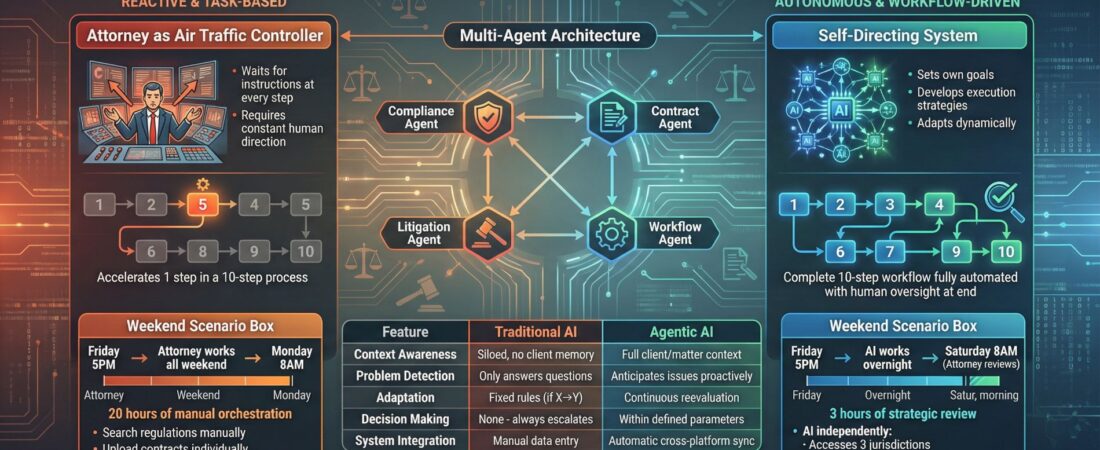
I remember the first time I watched a junior associate spend an entire weekend manually reviewing 200 vendor contracts, cross-referencing clauses against compliance requirements, and flagging inconsistencies in a spreadsheet. The associate was brilliant, meticulous, and completely exhausted by Monday morning.
Half the flagged items were false positives that a more experienced partner immediately dismissed.
That scene haunts me because it represents everything broken about how legal work has traditionally operated. We’ve built an entire professional infrastructure around the assumption that smart humans grinding through repetitive tasks is just the cost of doing business. We’ve accepted that attorneys should spend 40% of their billable hours on work that doesn’t require legal judgment, that turnaround times measured in weeks are reasonable, and that only the largest firms can handle complex, multi-jurisdictional matters efficiently.
After working with firms implementing agentic AI, I’ve realized we weren’t just accepting inefficiency. We were accepting a fundamentally passive relationship with technology.
That passivity has been costing us far more than time and money.
It’s been costing us the ability to practice law at the level our clients deserve.
See our new list of the Top 10 Agentic AI Tools for Law Firms
What Traditional AI Actually Does in Legal Practice
When most legal tech companies talk about AI, they’re talking about sophisticated tools that are fundamentally reactive. You upload a contract, and the system highlights risky clauses.
You type a research question, and it retrieves relevant cases.
You feed it discovery documents, and it categorizes them by relevance.
These tools are genuinely impressive. They’ve legitimately improved legal practice.
But here’s the limitation that nobody wants to thank openly: they require constant human direction.
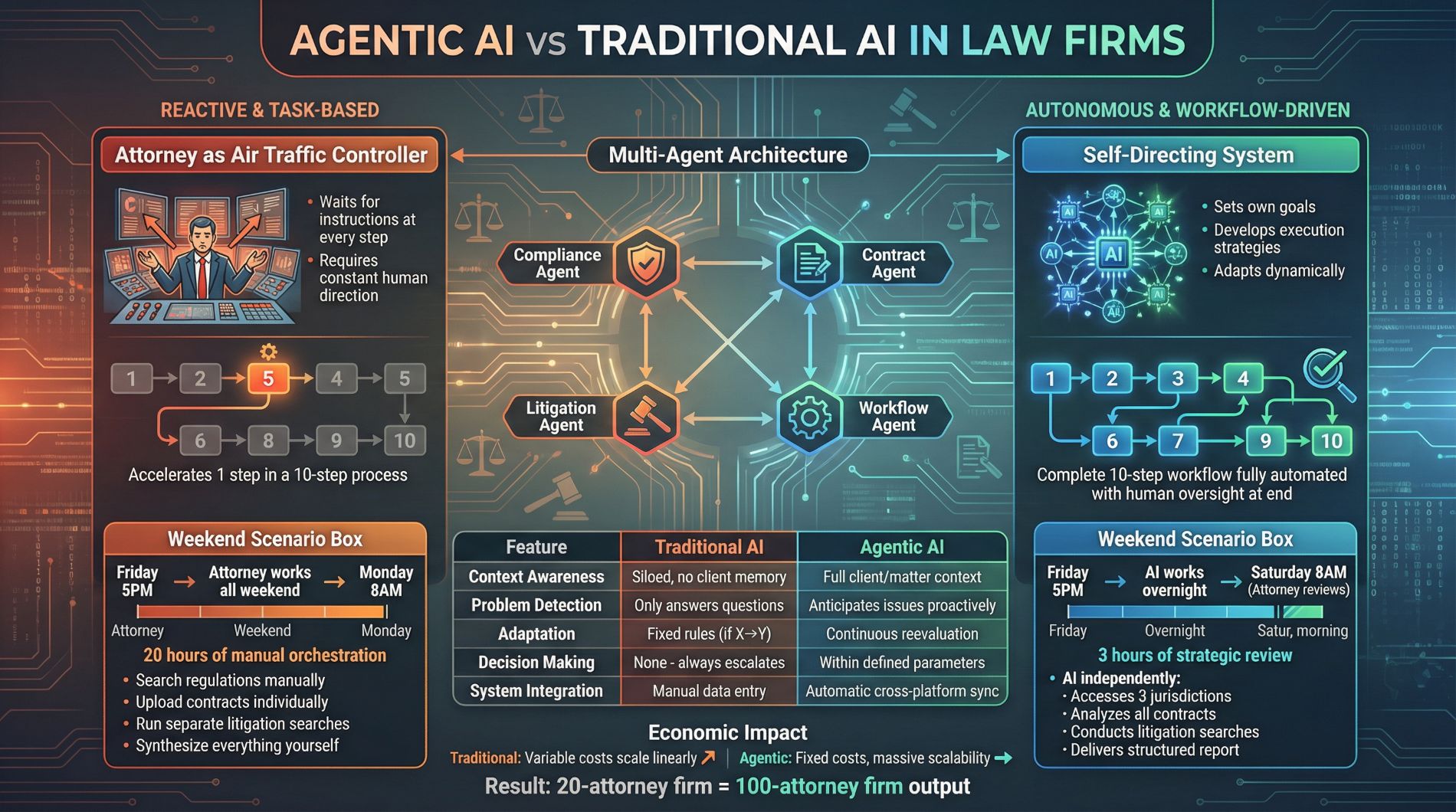
Every single step needs your input. You’re the air traffic controller, and the AI is waiting for your next instruction.
I watched a mid-size firm apply a contract review platform that everyone praised as transformative. Attorneys still had to manually collect all the contracts from various filing systems, upload them individually, review each flagged item, decide which concerns were material, draft suggested revisions, track which contracts had been updated, and follow up with counterparties.
The AI accelerated one step in a ten-step process. The attorney was still orchestrating everything else.
Traditional AI handles discrete, well-defined tasks brilliantly. It doesn’t manage workflows, adapt to changing circumstances, or make decisions within defined parameters.
It waits for you to tell it what to do next.
How Agentic AI Actually Works
Agentic AI operates from a completely different paradigm. Instead of waiting for instructions, these systems independently set goals, develop execution strategies, and adapt dynamically based on what they encounter.
They’re not just answering questions.
They’re managing entire workflows with minimal human intervention.
A concrete example illustrates the difference well. A corporate client sends an urgent email Friday afternoon requesting a comprehensive risk assessment of a potential acquisition target, including regulatory compliance analysis across three jurisdictions, identification of material contract obligations, and litigation risk evaluation.
They need preliminary findings by Monday morning for a board meeting.
With traditional AI tools, an attorney would spend the weekend manually orchestrating everything. Search for relevant regulations in each jurisdiction.
Upload target company contracts to a review platform.
Run litigation searches. Synthesize findings into a coherent report.
It’s doable, but it needs constant human direction and consumes the entire weekend.
With agentic AI, the attorney forwards the client email to the system Friday evening. The AI independently identifies the scope of work required, accesses relevant regulatory databases across all three jurisdictions, retrieves and analyzes the target company’s material contracts, conducts comprehensive litigation searches, identifies potential red flags based on the client’s risk tolerance profile, generates preliminary findings with supporting documentation, and delivers a structured report to the attorney’s inbox Saturday morning for review and refinement.
The attorney spends Saturday morning reviewing the analysis, adding strategic insights that require professional judgment, and refining the presentation for the client. What would have consumed 20 hours of grinding work takes three hours of high-value strategic thinking.
The analysis is more thorough because the AI didn’t get fatigued after reviewing the 50th contract.
The Multi-Agent Collaboration Architecture
The real power behind agentic systems comes from many specialized agents collaborating intelligently on complex problems. Think about how law firms organize work.
You don’t have generalists handling everything.
You have specialists who contribute domain expertise to create comprehensive solutions.
A real estate transaction might involve an attorney who understands zoning regulations, another who handles environmental compliance, and a third who specializes in financing structures. They collaborate, with each person contributing their specific knowledge.
Agentic AI mirrors that collaborative structure, but with specialized AI agents instead of human specialists. One agent might focus exclusively on regulatory compliance analysis.
Another specializes in contract risk assessment.
A third handles litigation prediction modeling. A fourth manages matter workflow and coordination.
When a complex legal matter arrives, these agents don’t just run in parallel. They actively collaborate.
The compliance agent identifies jurisdiction-specific requirements that the contract agent uses to assess whether proposed terms satisfy those requirements.
The litigation agent assesses whether certain contract provisions increase exposure based on recent case trends. The workflow agent confirms that findings are routed to the right people at the right time and that deadlines are tracked automatically.
I’ve seen this architecture handle situations that would typically require coordination meetings between three different practice groups. A client needs to structure a cross-border transaction that triggers securities regulations in two countries, needs environmental impact assessments, involves intellectual property transfers, and has specific tax optimization requirements.
Traditionally, you’d schedule many meetings, create shared documents, track who’s responsible for which analysis, and manually synthesize everyone’s input. The agentic system assigns specialized agents to each domain simultaneously, allows them to identify interdependencies automatically, flags conflicts or gaps in the analysis, and produces a coordinated strategy that accounts for all considerations.
The human attorneys review the synthesized analysis and make strategic decisions based on vastly more finish information than they’d typically have at this stage.
Contextual Awareness Changes Everything
The difference between isolated point solutions and systems with genuine contextual awareness is absolutely transformative. Traditional AI tools operate in information silos.
Your contract review platform doesn’t know anything about your client’s broader business goals, risk tolerance, or strategic priorities.
Your legal research tool doesn’t understand the specific matter context or how the research fits into your litigation strategy. Each tool needs you to provide context manually every single time.
Agentic AI maintains contextual awareness across entire matters and client relationships. It understands that Client A is aggressively growth-oriented and comfortable with moderate regulatory risk, while Client B operates in a heavily regulated industry and prioritizes conservative compliance approaches.
It knows that Matter X involves a first-time counterparty requiring thorough due diligence, while Matter Y is a routine transaction with a long-standing partner where streamlined processing is suitable.
This contextual awareness enables the system to adapt its approach automatically. When reviewing a licensing agreement for the risk-averse client, the agentic system flags potentially ambiguous termination clauses and suggests conservative clarifying language.
When reviewing a similar agreement for the growth-oriented client, it focuses on provisions that might limit strategic flexibility and suggests terms that preserve optionality.
I watched this play out with a firm that represented both early-stage startups and established enterprises. The same contract template produced wildly different recommendations depending on which client it was for.
Startups got suggestions that maximized flexibility and minimized upfront commitments.
Established enterprises got recommendations focused on predictability and risk containment. The AI wasn’t just reviewing contracts.
It was applying client-specific strategy.
Proactive Problem Identification
One of the most valuable capabilities that distinguishes agentic systems is genuinely proactive problem identification. Traditional AI responds to what you ask it.
Agentic AI anticipates what you should be thinking about.
A corporate client is negotiating a supply agreement with a vendor in a different jurisdiction. The agentic system reviews the proposed terms, identifies standard risks, and then goes further.
It recognizes that the vendor’s jurisdiction recently passed legislation affecting cross-border data transfers that will take effect in six months.
The current agreement terms don’t address this, creating potential compliance exposure.
Nobody asked the AI to research upcoming regulatory changes in the vendor’s jurisdiction. It identified a potential issue based on contextual understanding of the transaction, proactively researched relevant regulatory developments, assessed the materiality of the risk, and flagged it for attorney review.
That kind of proactive analysis would typically only happen if a very experienced attorney specifically thought to research recent regulatory changes in that jurisdiction.
I’ve seen agentic systems identify conflicts of interest that weren’t immediately obvious, flag inconsistencies between related transaction documents that were drafted weeks apart, and surface relevant case law developments that occurred after initial research was completed. These aren’t responses to specific queries. They’re independent analysis based on continuous monitoring and contextual understanding.
Decision-Making Within Defined Parameters
This is where a lot of attorneys get nervous. The nervousness is justified if the system isn’t designed correctly.
The question is when should AI make decisions independently versus escalate to a human.
Well-designed agentic systems operate within clearly defined parameters that the firm or attorney establishes. For routine matters with established procedures and low risk profiles, the system can make decisions independently.
For matters involving significant risk, novel legal issues, or client relationship sensitivities, the system escalates to human review.
A practical example: engagement letter generation for new clients. Once a prospective client passes conflict checks and the attorney decides to accept the representation, the agentic system can independently generate an engagement letter using approved templates, populate it with matter-specific information, route it for attorney review if the matter type or fee structure is non-standard, get necessary signatures electronically, and file the executed agreement in the matter management system.
The attorney isn’t micromanaging each step, but they maintain control over what the system can decide independently. If the prospective client requests fee arrangements that fall outside standard parameters, the system escalates that for attorney decision-making as opposed to proceeding independently.
This approach dramatically reduces the administrative burden on attorneys while maintaining suitable professional oversight. I’ve talked with partners who estimate that proper implementation of agentic intake and engagement processes saves 4-6 hours per week per attorney just on administrative coordination that used to require constant attention.
Dynamic Adaptation and Continuous Reevaluation
Traditional AI follows pre-programmed rules. If X happens, do Y.
If conditions change, it continues following the original instructions until a human intervenes and provides new directions.
Agentic AI continuously reevaluates its strategy based on changing circumstances. A litigation matter is headed toward trial.
The agentic system is managing discovery review, tracking deadlines, coordinating expert witnesses, and monitoring relevant case law.
Three weeks before trial, opposing counsel files a motion that introduces a novel legal theory.
The agentic system recognizes this as a material development, automatically starts focused research on the specific legal theory, identifies cases where similar arguments were raised, analyzes outcomes and distinguishing factors, flags the development for immediate attorney attention, and suggests potential response strategies based on successful arguments in analogous cases.
It didn’t wait for the attorney to notice the filing and issue new research instructions. It recognized changed circumstances and adapted its approach accordingly.
That level of responsiveness is really valuable in fast-moving litigation where developments can change strategy significantly.
I’ve also seen this work in transactional contexts. A merger agreement is being negotiated, and the agentic system is tracking terms, flagging issues, and managing the coordination between many workstreams.
Midway through negotiations, one party introduces an earnout provision tied to future performance.
The agentic system recognizes this as a material change, automatically flags related provisions that now need adjustment like indemnification terms, dispute resolution procedures, and accounting methodology definitions. It identifies potential tax implications and suggests coordinated revisions across all affected sections.
The Integration Hub Function
Here’s a problem that drives legal operations professionals absolutely crazy: information silos between systems. Client data lives in the CRM.
Matter information lives in the practice management system.
Documents live in the document management system. Billing lives in the accounting system.
Getting information to flow between these systems needs manual data entry, custom integrations that break with every software update, or middleware solutions that add complexity and cost.
Agentic AI can function as an integration hub that automatically routes information between systems based on contextual understanding. When a new client is accepted, the agentic system doesn’t just update the CRM.
It creates the client record in the practice management system, establishes suitable document folders with correct access permissions, initializes billing arrangements in the accounting system, adds relevant calendar deadlines, assigns matter team members, and triggers intake checklists.
This happens because the agentic system understands that accepting a new client triggers many downstream actions and it can interact with various systems to execute those actions.
I watched a firm apply this kind of integration, and the operations director described it as finally having someone who actually reads the process manual and follows it consistently. Attorneys weren’t forgetting to update systems or skipping steps because they were too busy.
The agentic system was handling the coordination automatically.
Quality Control and Verification Architecture
The difference between consumer-grade AI and professional-grade agentic systems for legal work comes down substantially to quality control and verification architecture. When you use ChatGPT for legal research, you’re accessing a system trained on large web-based data that includes accurate legal information, outdated information, incorrect information, and fictional cases generated by other AI systems.
There’s no verification architecture ensuring that what it tells you is accurate.
Professional-grade agentic AI for legal work connects to authoritative legal databases, verifies information against primary sources, cites specific statutory provisions and case citations that can be independently verified, and operates within architectural constraints that prevent hallucination of non-existent authorities.
This verification architecture is absolutely essential for professional legal work. The consequences of relying on fabricated case law or outdated statutory provisions are severe, including malpractice liability, sanctions, and damage to professional reputation.
Systems designed for legal practice need to guarantee that their output is verifiable and based on authoritative sources.
When evaluating agentic AI systems, firms should specifically ask about verification architecture, what databases the system accesses, how it confirms accuracy of legal citations, what safeguards prevent hallucination, and what quality control mechanisms are built into the system. Those aren’t optional features.
They’re basic requirements for professional use.
Implementation Workflow Design
Getting agentic AI to work in a law firm environment needs thoughtful workflow design. You can’t just turn on the system and expect immediate transformation.
You need to map existing workflows, identify which decisions can be automated within defined parameters versus which require human judgment, establish clear escalation protocols, and train the system on firm-specific approaches.
The firms I’ve seen succeed with implementation take a phased approach. They start with a specific, well-defined workflow where the value is clear and the parameters are relatively straightforward.
Client intake and engagement is often a good starting point because it’s administratively intensive, follows fairly standard procedures, and produces immediate time savings that build enthusiasm.
Once that initial workflow is running smoothly, they expand to additional areas. Contract review and redlining is often next because it’s high-volume work with clear quality metrics.
Then legal research and memo generation.
Then matter management and deadline tracking. Over time, they build an interconnected system where many agentic capabilities work together seamlessly.
The firms that struggle are typically trying to apply everything simultaneously, haven’t clearly defined which decisions the system can make independently versus which require escalation, or haven’t invested adequate time in training the system on firm-specific approaches and client-specific preferences.
Cost Structure and Economic Implications
The economics of agentic AI are fundamentally different from traditional staffing models. Instead of variable costs that scale linearly with workload, where more work needs more attorney hours, agentic systems involve fixed technology costs with massive scalability.
Once implemented, the system can handle 10 matters or 1,000 matters with minimal incremental cost.
This creates really interesting strategic options for firms. They can accept matters that were previously unprofitable because the required attorney time couldn’t be recovered at market rates.
They can offer alternative fee arrangements that would have been too risky under traditional cost structures.
They can pursue market segments that were previously uneconomical to serve.
I’ve seen small and mid-size firms use agentic capabilities to compete for work that would traditionally go to much larger firms. They can deliver the thoroughness and responsiveness that used to require massive associate teams, but at cost structures that are dramatically lower.
That’s a genuine competitive advantage in markets where clients are increasingly pushing back on traditional billing models.
The flip side is that firms whose competitive advantage was primarily based on having more associates to throw at problems are facing pressure. If a 20-attorney firm with strong agentic capabilities can deliver similar work product as a 100-attorney firm using traditional methods, the larger firm’s size advantage diminishes significantly.
Frequently Asked Questions
What is agentic AI in legal practice?
Agentic AI refers to autonomous systems that can independently manage legal workflows, make decisions within defined parameters, and adapt to changing circumstances without constant human direction. Unlike traditional legal AI tools that wait for instructions, agentic systems proactively identify issues, coordinate many workstreams, and execute complex tasks with minimal oversight.
How does AI contract review actually work?
AI contract review systems analyze legal documents using natural language processing to identify key clauses, flag potential risks, and suggest revisions based on predefined criteria. Professional-grade systems connect to authoritative legal databases and can understand context specific to different clients, industries, and transaction types to provide tailored recommendations.
Can AI replace lawyers for legal research?
AI can’t replace lawyers but it can dramatically accelerate legal research by quickly searching vast databases, identifying relevant cases and statutes, and synthesizing findings. Attorneys still need to assess the research strategically, apply professional judgment to novel situations, and craft arguments that require human understanding of legal principles and persuasive reasoning.
What are multi-agent AI systems?
Multi-agent AI systems consist of many specialized AI agents that collaborate on complex tasks. In legal practice, different agents might handle regulatory compliance, contract analysis, litigation strategy, and workflow management, working together to provide comprehensive solutions that would traditionally require coordination between many human specialists.
How much does agentic AI cost for law firms?
Implementation costs vary widely based on firm size, practice areas, and integration complexity. Initial investments typically include licensing fees, integration services, and training time.u003cbru003eThe economic model shifts from variable staffing costs to fixed technology expenses, creating scalability advantages where marginal costs decrease significantly as usage increases.
Is AI-generated legal work admissible in court?
Courts increasingly scrutinize AI-generated legal work, particularly after high-profile cases involving fabricated citations. Work product must be thoroughly verified by licensed attorneys who take professional responsibility for accuracy.u003cbru003eMany jurisdictions require disclosure when AI tools contribute substantially to legal filings, and attorneys stay liable for any errors regardless of how they were generated.
What security concerns exist with legal AI systems?
Major security concerns include data confidentiality, unauthorized access to privileged information, whether client data trains models accessible to others, cloud storage vulnerabilities, and third-party vendor reliability. Firms must confirm AI systems comply with professional responsibility rules regarding client confidentiality and apply robust cybersecurity measures to protect sensitive information.
Can small law firms afford agentic AI technology?
Many agentic AI providers offer scalable pricing models that make the technology accessible to smaller firms. The competitive advantage is particularly significant for small practices because these systems provide capabilities that were previously only available to large firms with substantial associate teams, leveling the playing field in client service and operational efficiency.
Key Takeaways
Agentic AI represents a basic shift from passive tools to autonomous systems that independently manage complex legal workflows. The distinction is operational autonomy, contextual awareness, and proactive problem-solving that traditional AI simply doesn’t provide.
The value comes from multi-agent collaboration enabling comprehensive analysis, contextual awareness allowing client-specific adaptation, dynamic response to changing situations, and continuous learning through feedback loops.
Implementation needs thoughtful workflow design, clear parameters defining when systems can make independent decisions versus when they must escalate for human review, robust verification architecture ensuring accuracy, and change management that addresses cultural resistance honestly. The competitive implications are significant.
Early adopters are gaining substantial advantages in efficiency, scalability, and cost structure that translate into better client service at lower internal costs.
Human oversight stays essential. Agentic AI enhances as opposed to replaces legal professionals, handling routine, data-intensive work while freeing attorneys to focus on strategy, judgment, and client relationships that genuinely require professional expertise.
The firms that succeed will be those that view agentic AI as augmenting attorney capabilities as opposed to threatening attorney roles.