A Year After Microsoft’s Singapore AI Summit: Are Asian Law Firms Finally Cashing In on Copilot—Or Still Hitting the Brakes?
It’s been almost a year since that buzzworthy Microsoft AI for Law Firms Summit wrapped up in Singapore (late 2024). Back then, the room was packed with skeptical partners wondering if generative AI was a shiny toy or a real game-changer. Fast forward to now—December 2025—and the big question on every managing partner’s mind is: Did we miss the boat, or is this thing actually delivering the goods without blowing up our ethics or data security?
Rhys McWhirter from Eversheds Sutherland nailed it post-event: the efficiency wins are “very obvious.” He’s not wrong. Tools like Microsoft 365 Copilot are quietly revolutionizing the grunt work—summarizing marathon client calls, digging out buried clauses in monster contracts, or whipping up those boilerplate emails that used to eat hours. Firms aren’t leaping into full-blown AI legal advice yet (smart move, given the hallucination horror stories), but they’re nailing the admin side.
Take Linklaters: They’ve pushed Copilot out to nearly 6,000 people globally. Partner Adrian Fisher swears by having rock-solid “ownership” rules—who deploys it, who updates policies—as the secret sauce to making it last. Microsoft’s own in-house lawyers clocked 32% faster task completion and 20% better accuracy in trials. That’s the kind of number that turns heads in a billable-hours world.
Over in Singapore, Rajah & Tann has gone all-in, with over 80% of staff using Copilot daily. Meeting minutes that took days? Now hours. They’ve even built custom gems like an AI HR bot that handles routine queries on autopilot. Ashurst’s Hoi Tak Leung puts it bluntly: “Just get amongst it.” Dive in, experiment—plenty of backup from Microsoft and the Singapore Academy of Law.
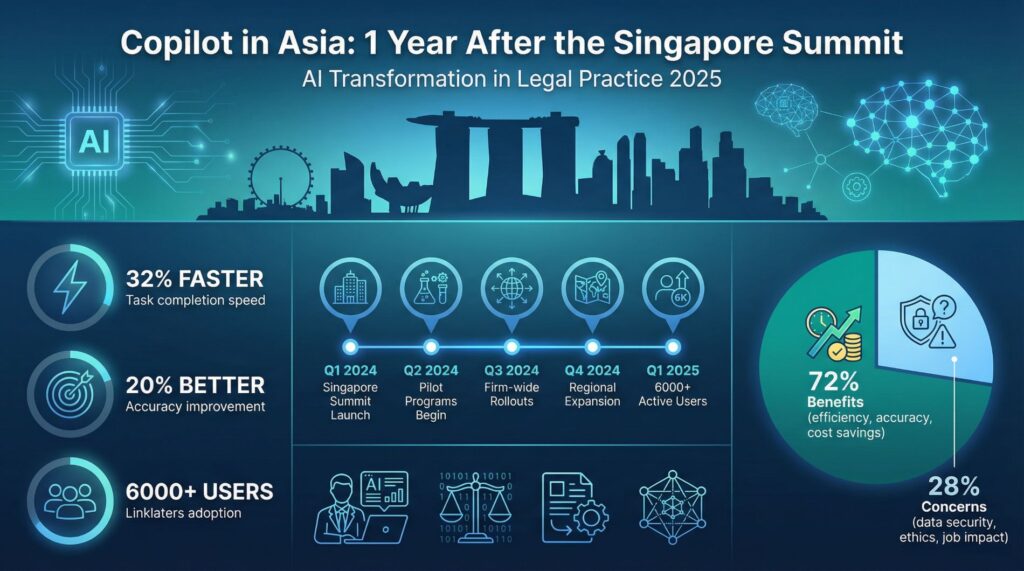
But let’s not sugarcoat it. Plenty of firms are still dragging their feet. That summit poll showed nearly a quarter had zero rollout timeline. Data privacy nightmares, bias risks, ethical tightropes—those haven’t vanished. And with no splashy follow-up summit announced for 2025 or beyond (Microsoft’s shifted to broader pushes like partner integrations and sovereign data controls), it’s on individual firms to steer the ship.
The real hot-button debate? Jobs versus juice. AI isn’t slashing headcount—yet. Instead, it’s freeing lawyers for the juicy stuff: killer strategy, tough negotiations, deeper client bonds. Smarter billing, maybe even value-based over hours. Better work-life balance? In theory, yes—fewer late nights on summaries.
As we roll into 2026, Asian legal scenes look poised for takeoff. Wariness is fading, replaced by pragmatic pilots and secure rollouts. Microsoft’s kept the momentum with things like in-country data processing options (coming to more spots soon) and deeper ties in regulated sectors.
Threat or turbo-boost? Most insiders are leaning turbo. But only the bold ones training teams, locking down governance, and starting small are gonna lap the pack. What’s your firm doing—riding the wave or watching from the shore? The clock’s ticking.