Email marketing for attorneys generates higher returns than most other marketing channels. Your email list contains people who already know your firm exists and have shown interest in your services.
This puts you ahead of cold outreach or paid ads where you start from zero.
When you send the right message to the right person at the right time, email keeps your firm top of mind. Past clients remember you exist when they need legal help again. Prospects move from considering your services to actually scheduling consultations.
Referral sources think of you when someone asks for attorney recommendations.
The difference between email marketing that works and email that gets deleted comes down to strategy. You need the right foundation, compliant practices, and content that people actually want to read.
Why Email Marketing Matters for Law Firms
Your competitors spend thousands on Google ads and social media campaigns. Those channels need constant spending to maintain visibility.
Email marketing for attorneys costs less and produces better results over time.
You own your email list. Social media platforms can change their algorithms tomorrow and tank your reach.
Your email subscribers stay yours regardless of what happens with other marketing channels.
Email reaches people in their inbox, a space they check many times per day. Your message sits there until they read it or delete it.
Social posts disappear in feeds after minutes.
Ads stop showing the moment you stop paying.
The return on investment speaks for itself. Most marketing experts cite email as delivering $36-42 for every dollar spent.
Your firm keeps that advantage when you do it correctly.
Building Your Email List the Right Way
Your list quality matters more than size. A list of 300 engaged subscribers who open your emails beats 3,000 contacts who never read anything you send.
Start with people who already know you. Past clients who agreed to stay in touch form your foundation.
People who downloaded resources from your website opted in by taking that action.
Anyone who attended your webinars or events and provided their email address belongs on your list.
You can add a newsletter signup form on your website. Place it on your homepage, blog posts, and contact page.
Make the value clear, explain what subscribers get and how often you send emails.
Never buy email lists or add people without permission. This violates anti-spam laws and damages your sender reputation.
Email platforms will flag your account if too many recipients mark your messages as spam.
Collect emails at speaking engagements and networking events. Keep a signup sheet or use a tablet where people can enter their information.
Always mention what they’re signing up for and get explicit consent.
Your website contact forms should include an optional checkbox where visitors can opt into your newsletter. Keep this box unchecked by default so people actively choose to subscribe.
Choosing an Email Marketing Platform
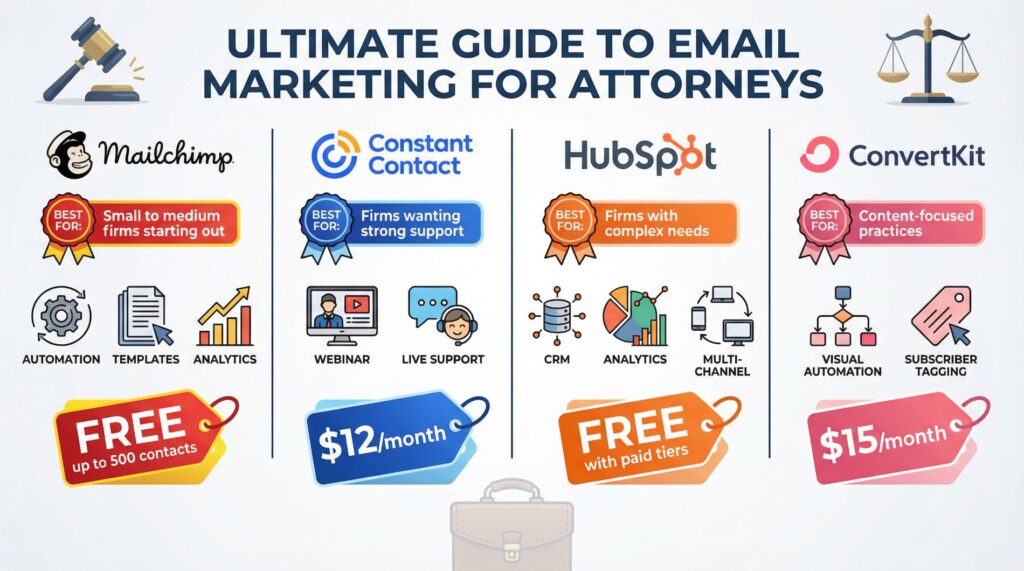
Email marketing for attorneys needs specific features that standard platforms might not offer. You need automation, segmentation, compliance tools, and templates designed for professional services.
Mailchimp works well for most law firms starting out. The interface makes sense without technical knowledge.
You get automation, list segmentation, and pre-built templates.
The free tier let’s you test email marketing before committing to paid plans.
Constant Contact focuses on small businesses and professional services. The platform includes webinar hosting, which helps if you run educational sessions for clients.
Customer support responds quickly when you need help setting up campaigns.
Get started with Constant Contact’s professional services package and access templates specifically designed for attorneys and law firms.
HubSpot offers more advanced features if your firm handles complex marketing across many channels. The CRM integration tracks which emails lead to consultations and new clients.
This platform costs more but provides deeper insights.
ConvertKit specializes in automated sequences and subscriber management. The visual automation builder let’s you create complex follow-up campaigns without coding.
Attorneys who send different content to different practice area subscribers benefit from these features.
Your platform choice depends on your budget and needs. Start with basic features and upgrade as your email strategy grows. All major platforms let you export your list if you decide to switch later.
Compliance and Legal Requirements
Anti-spam laws protect recipients from unwanted emails. Breaking these rules costs thousands in fines per violation.
Your firm can’t afford to ignore compliance.
The CAN-SPAM Act applies to all commercial emails sent in the United States. You must include your firm’s physical address in every email.
Your subject lines need to accurately reflect the email content.
Recipients get a clear way to unsubscribe, and you must honor those requests within 10 business days.
GDPR affects you if you email anyone in the European Union. This law needs explicit opt-in consent.
Pre-checked boxes don’t count.
You need to store data securely and allow people to ask deletion of their information.
Canada’s CASL carries some of the strictest penalties. One company paid over $1 million for sending unsolicited emails.
Get express consent before adding Canadian contacts to your list.
Your state bar association has additional rules about attorney advertising. Most need you to label marketing emails as attorney advertising.
You can’t guarantee specific outcomes or make misleading claims about your success rate.
Never talk about actual client cases without written permission. Confidentiality rules apply to your email marketing just like any other communication.
Use generic examples or sanitize details to protect privacy.
Mailchimp automatically includes required compliance elements in your email templates, reducing your risk of accidentally violating anti-spam laws.
Creating Content That Clients Actually Read
Most attorney emails are boring. Long lists of legal updates, firm announcements nobody cares about, and obvious tries to drum up business fill inboxes every day.
Your emails need to stand out by providing actual value.
Write about topics your clients ask about during consultations. Real estate attorneys can explain what different contract clauses mean.
Employment lawyers can break down recent changes to workplace regulations.
Personal injury attorneys can guide people through the claims process.
Keep paragraphs short. Three to four sentences most.
Long blocks of text make people’s eyes glaze over, especially on mobile devices.
Subject lines decide whether anyone opens your email. Keep them under 50 characters.
Make them specific as opposed to vague.
“Three estate planning mistakes that cost families thousands” works better than “Legal tips for you.”
Your first sentence needs to hook readers immediately. Start with a relevant problem or interesting fact.
Explain why they should care about this particular email right now.
Include one clear call to action per email. Tell readers exactly what to do next.
“Schedule your free consultation” or “Download the finish guide” gives them a specific next step.
Videos increase engagement significantly. Record short explanations of common legal questions.
Show your office and introduce team members.
Keep videos under two minutes so people actually watch them.
ConvertKit makes it easy to send targeted content to specific segments of your list, so real estate clients only get real estate content and corporate clients only get corporate updates.
Segmentation Strategies for Attorneys
Sending the same email to everyone on your list wastes opportunities. Different people need different information at different times.
Segment by practice area first. Your personal injury contacts don’t care about corporate compliance updates.
Your business clients don’t need information about workers’ compensation claims.
Create segments based on where people are in the client journey. Past clients need different content than active clients.
People who requested consultations but haven’t scheduled need different follow-up than cold subscribers.
Location matters for many practice areas. Local law changes, court updates, and community events only matter to people in specific geographic areas.
Tag subscribers by location and send relevant updates.
Segment by how engaged people are with your emails. Subscribers who open every email can handle more frequent communication.
People who rarely open anything need re-engagement campaigns or should be removed from your list.
Create a VIP segment for referral sources. These contacts get special attention because they send business your way.
Share updates about your firm’s capabilities and stay top of mind.
Automation That Saves Time
Email marketing for attorneys needs consistency. Automation handles repetitive tasks so you can focus on serving clients.
Set up a welcome sequence for new subscribers. The first email introduces your firm and sets expectations.
The second email shares your most valuable content.
The third email includes a soft call to action to schedule a consultation.
Appointment reminders reduce no-shows. Send an automated reminder three days before the appointment and another one the day before.
Include clear instructions for how to reschedule if needed.
Follow up with consultation requests automatically. Someone fills out your contact form at 9pm on Saturday.
Your automation sends them a confirmation immediately and follows up on Monday morning to schedule a call.
Birthday and anniversary emails maintain relationships with past clients. Set up automation to send a brief message on important dates.
This keeps your firm fresh in their minds without manual tracking.
Re-engagement campaigns target subscribers who haven’t opened emails in six months. Send a series asking if they still want to hear from you.
Remove people who don’t respond to keep your list clean and your sender reputation strong.
HubSpot’s CRM integration let’s you track exactly which automated emails lead to booked consultations and new client relationships.
Measuring What Matters
Open rates show whether your subject lines work. Most industries average 20-25% open rates.
Law firms often see slightly lower numbers because legal content feels less urgent than other topics.
Click-through rates reveal whether your content engages readers. Track which links get clicked most often.
This tells you what topics resonate with your audience.
Conversion rates matter most. An email that gets opened and read but doesn’t generate consultations, calls, or website visits needs improvement.
Track how many people take your desired action.
Unsubscribe rates show content problems. Losing 0.5% or less of your list per email is normal.
Higher rates mean you’re emailing too often or sending content people don’t want.
Bounce rates show list quality issues. Soft bounces happen when inboxes are full.
Hard bounces mean email addresses don’t exist anymore.
Remove hard bounces immediately to protect your sender reputation.
Test one variable at a time. Try different subject lines while keeping content the same.
Change send times while maintaining everything else.
This shows you exactly what changes produce better results.
Split test with small segments first. Send version A to 10% of your list and version B to another 10%.
Wait for results, then send the winner to the remaining 80%.
Best Practices for Attorney Email Marketing
Send emails consistently but not excessively. Monthly newsletters work for most law firms.
Add occasional timely updates about major legal changes or firm news.
Mobile optimization is mandatory. Over 60% of emails get opened on phones.
Test how your emails look on small screens before sending.
Use plain text or simple HTML templates. Complicated designs with lots of images often trigger spam filters.
Simple formatting loads faster and looks professional.
Personalize beyond just first names. Reference the specific practice area someone inquired about.
Mention their location.
Acknowledge their history with your firm.
Keep accessibility in mind. Use alt text for images.
Choose readable font sizes.
Ensure enough color contrast. Screen readers need to work with your content.
Clean your list regularly. Remove contacts who haven’t engaged in 12 months.
This improves your deliverability and keeps your costs down on platforms that charge by subscriber count.
Write like you talk. Legal jargon confuses people and makes them stop reading.
Explain complex concepts in simple terms.
Imagine you’re talking to a friend who needs your help.
Moving Forward with Email Marketing for Attorneys
Email marketing for attorneys works when you commit to providing value consistently. Your subscribers need information they can use, not sales pitches disguised as newsletters.
Start small with a welcome sequence and monthly newsletter. Add automation as you learn what your audience responds to.
Test different content types and track what generates the best results.
The firms that win with email marketing treat it as relationship building as opposed to advertising. Every email strengthens your connection with past clients, prospects, and referral sources.
Your email list grows more valuable over time. These people already know your firm exists and have shown interest in what you do.
That foundation costs nothing to maintain once established and continues generating returns for years.
Choose your platform, build your list properly, and start sending emails that people actually want to read. The technical aspects get easier with practice.
The strategy comes from understanding what your clients need and when they need it.
Table: Email Marketing Platform Comparison for Law Firms
| Platform | Best For | Key Features | Starting Price |
|---|
| Mailchimp | Small to medium firms starting out | Automation, templates, basic analytics | Free up to 500 contacts |
| Constant Contact | Firms wanting strong support | Webinar hosting, live chat support | $12/month |
| HubSpot | Firms with complex needs | Full CRM, advanced analytics, multi-channel | Free with paid tiers |
| ConvertKit | Content-focused practices | Visual automation, subscriber tagging | $15/month |
Your email marketing for attorneys strategy starts with picking the right foundation and committing to consistent execution. The results compound over months and years as your list grows and your understanding of what resonates deepens.